Case fileEF-008Vitebsk, 1971
The Man With the Red Armband: 36 Murders the Soviet Union Refused to See
For fourteen years, women vanished along the roads of the Vitebsk region of Soviet Belarus, and the state kept solving the murders: fourteen innocent people were convicted, one was shot, one went blind in the camps, one was broken in a psychiatric ward. The real killer was a respected mechanic, a married father of two, and the commander of a volunteer police patrol.
We did not remove the tumor.
Nikolai Ignatovich, the first Prosecutor General of independent Belarus, asked what the Vitebsk affair had shown
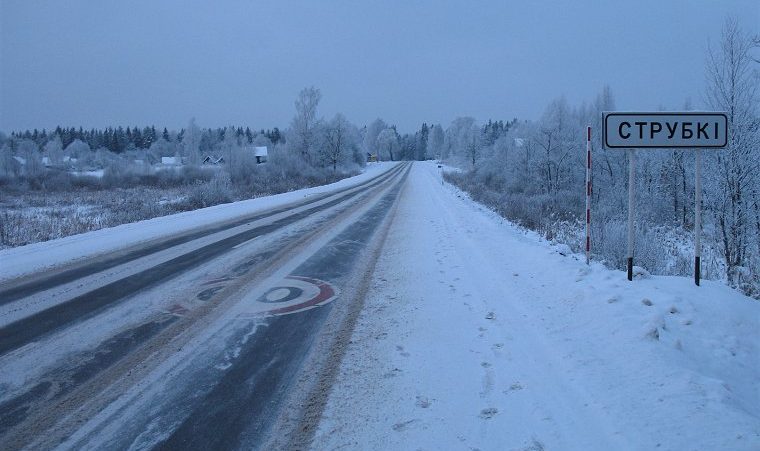
A road in the Vitebsk region in winter. Paju, CC BY-SA 3.0 (source)
The film
At a glance
- Period
- 1971 to 1987
- Country
- Soviet Belarus (today Belarus)
- Subject
- Gennady Mikhasevich, mechanic and commander of a volunteer police patrol
- Key locations
- Vitebsk, Polotsk, Novopolotsk, Minsk, Beshenkovichi, Mozyr
- Themes
- eastern files, true crime, soviet union, belarus, vitebsk, gennady mikhasevich
- Episode
- EF-008 · 35 min · published 11 July 2026
Case overview
He wore the red armband. He stood at the roadblocks set up to catch him, checking drivers' documents, searching for himself. This is the Vitebsk case: the murders, the confession machine that fed on the innocent, the letter that finally betrayed the killer's hand, the half-million handwriting samples, and the reckoning that never quite came.
One more thing outlived everyone. Pishchalauski prison, where Mikhasevich was shot, did not retire with the Soviet Union. Belarus remained the last country in Europe still carrying out executions, and for another generation the sentences were carried out behind those same walls, until 2024. As for the case, it survives in its relics: a photograph of a puppy that stood where evidence should have stood; a letter in a costumed hand; a handcuff eaten through with rust; and a red armband, the kind issued to the men a state believes it can trust.
Timeline
Fourteen years later, a man would sit across a table from his interrogators and tell them about that night in May. He was twenty-four then, and he was walking the dark road home because the last bus had gone. He was carrying a rope. He meant, he said, to hang himself. Somewhere on that road, in the dark, he met a nineteen-year-old woman walking alone.
What he told his interrogators he thought in that moment is in the record, and it is one of the coldest sentences in the file. Why should I choke myself over a woman, he said. Better I strangle one myself. The rope he had brought for his own neck went around hers. He hid her body and he walked home, and nobody looked at him twice, not that night and not for fourteen years afterward.
In October of that year he attacked again, near a factory on the edge of Vitebsk, and this time the road was not empty. Schoolchildren came down the path with a flashlight, voices carrying in the dark, and he let go of the woman and ran. She lived. She is the only person known to have survived him. She went to the militia, and the militia decided the matter was not serious enough to register.
And by the account he later gave, before that same night was out, he had followed another woman from a bus stop and killed her. Two women dead, one survivor, one report turned away. The year was 1971, and the system had already shown, in miniature, everything it was going to do.
Related documentsAnd in 1974, in Polotsk, the machine delivered its first great answer. Three local men, Nikolai Yanchenko, Valery Kovalyov and Vladimir Pashkevich, stood trial for three of the murders. The case had been built in the house style. A witness had seen three men with a dog somewhere near one of the scenes. That was the seed. The pressure rooms did the rest.
The evidence against them included an exhibit that deserves to be remembered wherever justice is taught. It was a photograph of a puppy. A small dog, photographed and entered into the case file over the caption: a dog of the German Shepherd type. That page stood in the file in the place where proof was supposed to stand. Kovalyov was sentenced to fifteen years. Pashkevich to twelve. Yanchenko to two and a half.
Related documentsWhile the three men sat in the dock in Polotsk, something happened out on the roads. Or rather, nothing did. For the whole of 1974, not one woman was killed. If anyone in the procuracy wanted proof that the right men had been caught, the calendar itself seemed to offer it.
General Mechislav Grib, who would one day command the hunt for the real killer, says the explanation was sitting in the public gallery: the man the murders belonged to had come to Polotsk to watch the trial. The killings had stopped because the killer was attending court. When the trial ended, the quiet ended with it.
Related documentsIn 1979, investigators working one of the roadside murders picked up a man named Nikolai Terenya, a drifter with a record, the kind of man files love. He had come to their attention over a theft. Somewhere in the pressure rooms, the theft became the murder. And with him they took the woman he lived with, Lyudmila Kadushkina, because the case needed a witness, and a common-law wife describing her man's crime is the kind of witness no court of that era would question.
Related documentsTerenya never confessed. It is worth saying plainly, because almost everyone else in this story was made to: not in the cells, not at the trial, not at the end. It did not matter. The testimony had been obtained, the court accepted it, and the sentence was death. On a winter day in 1980 he was taken from his cell and shot. He was guilty of nothing except being convenient, and the state killed him for it.
And the machine was not finished with that household. Lyudmila Kadushkina, the witness it had manufactured, was herself convicted for her part in the affair and sent away to the camps. Sit with that for a moment. The state composed her testimony, forced her to speak it, used it to shoot her husband, and then imprisoned her for having taken part in the crime it had invented.
Related documentsIn 1981 Mikhasevich bought a car: a Zaporozhets, the small, loud, cheap car of the Soviet everyman. His was red. With it, the murders found their final form. He offered rides at bus stops along the roads between Vitebsk, Polotsk and Novopolotsk, in the hours when the buses thin out and a lift home is a small mercy.
A respectable man, a family car, a polite offer. The women who got in had done nothing careless. Everything in their world said this was safe, and their world was wrong.
Related documentsIn January 1984 a twenty-year-old woman named Tatyana Katsuba was murdered, and the case fell on a young man named Oleg Adamov. What was done to him went beyond even the house style. He was sent to the Novinki psychiatric hospital outside Minsk and held through a month of injections, and when the chemistry alone did not break him, a prosecutor named Valery Soroko forged the forensic report that sealed the case. Adamov tried to take his own life in custody. He lived, and he was sentenced to fifteen years.
Vladimir Gorelov was sentenced to twelve years for another of the murders. Six years in, his eyes failed him, and the state released a blind man back into the world it had taken him from. Others followed, and their names deserve at least the dignity of being said aloud: Lushkovsky. Mushinsky. Matskevich. Oryol. Blinov.
Related documentsAt the end of August 1984 Mikhasevich killed two women in a single day, on the road toward Beshenkovichi, west of Vitebsk. The deaths were handled the way everything in this story was handled: quietly. No newspaper printed a word about them. Almost nobody in the republic knew they had happened at all.
Remember that silence. The whole case is about to turn on it.
Related documentsIn January, the republic created something the doctrine said should never be needed: a unified operative group, run from Minsk under a militia general named Mechislav Grib, to look at the Vitebsk deaths as one thing. Looking at them as one thing was itself the revolution. An investigator named Nikolai Ignatovich had spent years re-reading the scattered files and arguing, to anyone who would risk listening, that the bodies by the Vitebsk roads were the work of a single man.
Witnesses had described, again and again, a small red car near the places where women vanished, and so the region's red Zaporozhets cars were catalogued, owner by owner. Checkpoints went up on the highways: militiamen in the winter dark, and beside them the volunteer order patrols the system called the druzhina, trusted citizens with red armbands, stopping cars, checking documents, the eyes of the state multiplied by its believers.
Related documentsIn the middle of August 1985, a letter arrived at the regional newspaper, the Vitebsk Worker, addressed to its acting editor, a man named Romanovsky. It was semi-literate, angry and strange. It announced that the women dying along the roads were not victims but sentences: executions, carried out on wives and girlfriends who had betrayed their men. It made threats and it made demands. And it was signed in the name of an organization nobody had ever heard of, because it did not exist: the Patriots of Vitebsk.
The letter boasted about the double murder on the Beshenkovichi road. The two women killed in one day in August 1984. The case that had never been printed anywhere, that almost nobody in the republic knew had happened. A madman can claim any murder he has read about. He cannot claim one that was never published. For the first time in fourteen years, the killer had volunteered a piece of himself: a page of his own handwriting.
Related documentsPeople who later reconstructed the investigation say the letter then spent weeks locked in a safe while the agencies argued over what it meant, and that while it lay there, two more women died. What ended the argument was the morning of the twenty-seventh of October 1985, when the last victim was found, and with her the detail this case has never been able to forget. Folded into her mouth was a note, in the same semi-literate hand. For treason, death, it read. The Patriots of Vitebsk.
He was no longer writing to the newspaper. He was leaving his signature on the dead.
Related documentsA killer who writes has given the state a fingerprint, and the state decided to take everyone's. What followed was one of the largest handwriting operations ever mounted anywhere: the script of an entire region, collected and read. Three hundred thousand passport application forms. Eighty thousand receipts. Seventy thousand newspaper subscription slips. Twenty thousand letters of complaint to the authorities.
More than half a million samples of ordinary Soviet paper, hauled out of archives and offices and read line by line by a team of some thirty handwriting experts, hunting for the hand behind the Patriots of Vitebsk.
Related documentsOn the twenty-fifth of November 1985, the sweep reached a stack of papers gathered by a district inspector named Veretennikov: routine explanatory notes, a few lines accounting for yourself to the militia, collected from the owners of red Zaporozhets cars. One note in the stack was wrong. The hand that wrote it kept changing its mind, the slant rebuilt, the letters reshaped, a man writing in a costume.
An expert named Tatyana Yerofeyeva set the disguised note beside the Patriots letter and read straight through the costume to the writer, the way you can know a voice on a bad telephone line. And the note had a name attached, because the form required one. It belonged to a thirty-eight-year-old mechanic from the Vitebsk countryside, the respected head of a collective farm repair workshop, a married father of two. His name was Gennady Mikhasevich.
Related documentsThey took Mikhasevich in December 1985. The men who made the arrest remembered finding him at a relative's house, his family around him and the suitcases already packed: tickets south, to Odessa. He denied everything, and witnesses recall him telling his wife it was a mistake, that he would be home soon. Then the searches began turning up what fourteen years of separate files had never managed to connect: things that had belonged to dead women.
Mikhasevich was a druzhinnik, a member of the volunteer patrols that helped the militia keep order, and not a rank-and-file one: the commander of his local squad. He wore the red armband. At the checkpoints thrown up across the region to catch the Vitebsk killer, he had stood beside the militia in the winter dark, stopping cars and checking drivers' documents, searching, with the full authority of the state, for himself.
Related documentsThrough the winter, Mikhasevich led them to the dead. Convoy after convoy went out to the roadsides while he pointed out the places, thirty-seven crime scenes reconstructed in all, the prisoner cuffed to a convoy officer by a tether welded shut for safety. He remembered everything: the years, the seasons, the small details of women whose files had long been closed around other people. He confessed, in the end, to forty-three murders, more than the investigation had ever connected.
General Grib has shown television crews what became of that welded handcuff. It was found, years later, eaten through with rust. Corroded, the general says, by what came off the man's skin during those drives. By his fear.
Related documentsThe trial opened in Minsk in 1987, and its very form was an admission of scale: not a Belarusian court but a collegium of the Supreme Court of the USSR itself, sitting in Minsk because the case had outgrown the republic. People who were at the courthouse say he was guarded there by the KGB, and that the KGB's concern was not the public. It was guarding him from the police, the men whose careers and convictions his confessions were taking down.
The numbers told the same story in layers. He had confessed to forty-three murders. The investigation stood behind some thirty-six. The court proved thirty-three, and his own prosecutor suspected the true count was higher than all of it.
A criminal case was finally opened against Mikhail Zhavnerovich, the investigator whose one hundred percent had been fed with broken people. It never reached a courtroom. In June 1987 the Soviet Union declared an amnesty to mark the seventieth anniversary of the Revolution, and Zhavnerovich, a decorated war invalid, qualified. The case was extinguished. He was expelled from the party; he kept his rank, his pension and his medals; and he died before the year was out.
It was not even the first time. In 1981, in the town of Mozyr, the same investigator had put six innocent men in prison for a single murder. They were freed two years later, and nothing changed, and nobody made him stop. The Vitebsk case was not one bad file. It was the system, working as designed.
Related documentsFrom custody, investigators recall, Mikhasevich explained himself without much drama. If I had stayed free, he said, I would have continued. It is an inseparable part of me. The sentence was death. He was shot at Pishchalauski prison in Minsk in the autumn of 1987, and the state handled his death the way it had handled his crimes: in silence.
The news agency announced the execution months afterward, the following February, in a dispatch a few lines long. Those who saw him last recall his final words. I will go to my girls.
Related documentsAround two hundred officials were sanctioned over the Vitebsk case: reprimanded, demoted, expelled, pensioned off, almost all of it along party lines, paperwork punishing paperwork. The investigator who had led the case against Nikolai Terenya took his own life. In the entire affair, exactly one official went to prison: Valery Soroko, the prosecutor who had forged the report that broke Oleg Adamov. He served four years, and years later he published a book justifying himself.
Related documentsThe fourteen were rehabilitated, one after another, the living and the dead. Nikolai Terenya's rehabilitation arrived years after the state had shot him: a piece of paper recording that he had been innocent all along, addressed to a man who no longer existed. The living received certificates too, and compensation.
Valery Kovalyov, one of the three men convicted over the photograph of a dog, was sentenced to fifteen years and served twelve, and he has told interviewers what the state's arithmetic of apology came to: three thousand seven hundred rubles, from which the accountants deducted the tax the Soviet Union charged its childless men. He had no children. He had spent the years a man has children in a labor camp, for a murder another man would one day describe to investigators from memory.
Related documentsNikolai Ignatovich, the investigator who had spent years saying the forbidden word, became, when the Soviet Union ended, the first Prosecutor General of independent Belarus. Mechislav Grib, the general who ran the hunt, went on to lead the state itself for a time in the nineties, and his signature sits under the first constitution of independent Belarus.
In his memoirs, Grib set down what he believed the case had been made of: corruption, and the merciless demand that investigators solve every case, at any cost. And he recorded one more detail, the right one to end the accounting on. The men who actually caught Gennady Mikhasevich fell into disfavour, he wrote. There were no decorations for them.
Related documentsThe last executions behind the same walls
Pishchalauski prison, where Mikhasevich was shot, did not retire with the Soviet Union. Belarus remained the last country in Europe still carrying out executions, and for another generation the sentences were carried out behind those same walls, until 2024.
Key locations
Full mapDocuments and evidence
Sources
- Documentary
Vitebskoye Delo (The Vitebsk Case), part 1 Belarusfilm, 1989.
The primary footage of the case: the interrogations, the investigative experiments, the handwriting exhibits and the wrongly convicted on camera.
- Documentary
Vitebskoye Delo, part 2: Nakazanie (Punishment) Belarusfilm.
- Documentary
- Documentary
- Documentary
Sasha Sulim, 2023: the interview with Mechislav Grib 2023.
General Grib has shown television crews what became of that welded handcuff. It was found, years later, eaten through with rust.
- Academic
Death Penalty in Belarus: Murder on (Un)Lawful Grounds FIDH report N 683a; the Vitebsk and Mazyr cases, printed pages 48 to 49, October 2016.
In his memoirs, Grib set down what he believed the case had been made of: corruption, and the merciless demand that investigators solve every case, at any cost.
- Web
Viasna, death penalty project: the Vitebsk (Mikhasevich) case
Nikolai Terenya's rehabilitation arrived years after the state had shot him: a piece of paper recording that he had been innocent all along, addressed to a man who no longer existed.
- Web
Zerkalo.io: the Zhavnerovich file and the roster of the fourteen
Count it all together and the number is this: fourteen innocent people, convicted of murders they did not commit. Thirteen men and one woman, the woman being Lyudmila Kadushkina, punished for testimony the state itself had written.
- Web
Lenta.ru, 5 October 2019: the long account of the Vitebsk case 5 October 2019.
She lived. She is the only person known to have survived him. She went to the militia, and the militia decided the matter was not serious enough to register.
- Web
RIA Novosti, 23 November 2017: the interview with Valery Kovalyov 23 November 2017.
Valery Kovalyov, one of the three men convicted over the photograph of a dog, was sentenced to fifteen years and served twelve, and he has told interviewers what the state's arithmetic of apology came to: three thousand seven hundred rubles, from which the accountants deducted the tax the Soviet Union charged its childless men.
- Web
- Web
- Web
SB.by, 23 August 2007: Sled manyaka, the forensic line of the case 23 August 2007.
An expert named Tatyana Yerofeyeva set the disguised note beside the Patriots letter and read straight through the costume to the writer.
- Newspaper
Komsomolskaya Pravda 15 December 2011.
The letter to the Vitebsk Worker printed in full, with interviews with General Grib and with Oleg Adamov.
- Web
Federal Chamber of Lawyers, 21 July 2021: how the innocent were made into killers 21 July 2021.
It was a photograph of a puppy. A small dog, photographed and entered into the case file over the caption: a dog of the German Shepherd type.
- Web
Argumenty i Fakty, 16 May 2019: the true history of the Vitebsk strangler 16 May 2019.
In the entire affair, exactly one official went to prison: Valery Soroko, the prosecutor who had forged the report that broke Oleg Adamov. He served four years.
- Web
Sputnik Belarus, 25 March 2024: the recollections of the investigator Lapshin 25 March 2024.
The men who made the arrest remembered finding him at a relative's house, his family around him and the suitcases already packed: tickets south, to Odessa.
- Book
Vitebskoye delo, ili dvulikaya Femida Minsk, 1993, 352 pages; serialized at buntar.by, 1993.
He served four years, and years later he published a book justifying himself.
- Archive
Belarusian State Archive of Film, Photo and Sound Documents
The collection credited on the archival case photographs published by Sputnik and RIA Novosti.
What remains unresolved
- Which failure do you find harder to forgive: the murderer the system refused to believe in, or the innocents it manufactured because believing was harder?
- And the Belarusian Maigret?