Case fileEF-025Nagyrév, 1929
The Angel Makers of Nagyrév
Nagyrév, a farming village on the river Tisza in Hungary, a Friday morning in July 1929. Two gendarmes and the village crier walk in single file along a plank fence to the midwife's house, and the crier's eight-year-old daughter, Mária, creeps after them through the bushes.
In this little village something is very wrong.
A letter to the Tiszakürt gendarme post, 12 July 1929
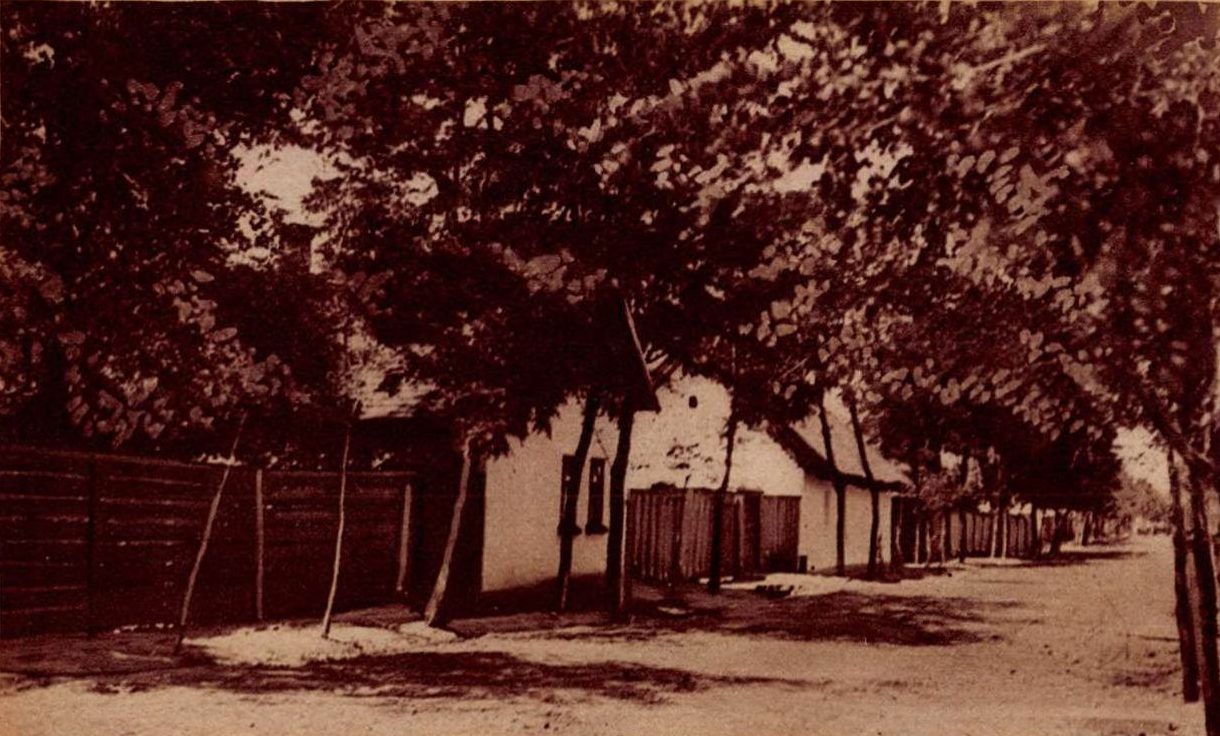
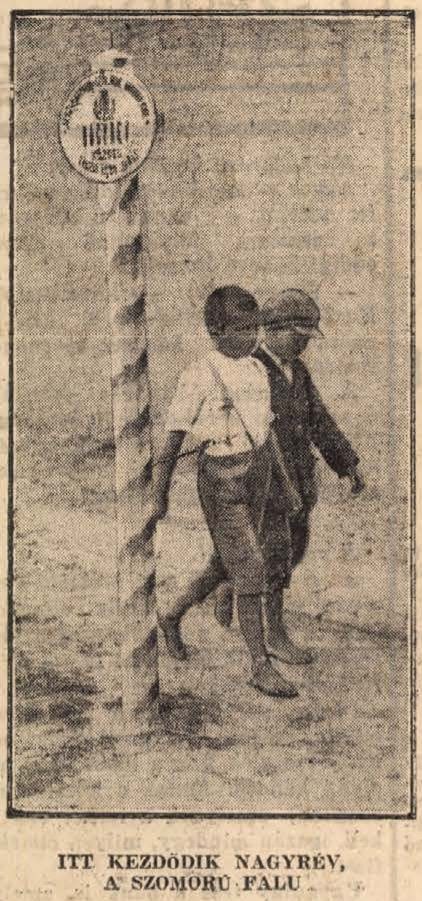
The midwife's street, Nagyrév, 1929. Pesti Napló, 18 August 1929 (source)
The film
At a glance
- Period
- 1921 to 2008
- Country
- Kingdom of Hungary (today Hungary)
- Subject
- The angel makers of Nagyrév, and the women who went to them
- Key locations
- Nagyrév, Tiszakürt, Cibakháza, Szolnok, Budapest, Márianosztra
- Themes
- Nagyrév, angel makers, Tiszazug, Zsuzsanna Fazekas, arsenic, flypaper, Szolnok trials, interwar Hungary
- Episode
- EF-025 · 67 min · published 30 October 2026
Case overview
Within days the gendarmes are opening graves in the village cemetery. Within two years three women hang at Szolnok.
This Halloween special follows what some villagers did to their own husbands, parents and children with arsenic soaked out of flypaper; the warnings that went unheeded for years while the register of deaths filled up with consumption, old age and heart weakness; and how arrests, trials and sensational newspaper stories turned the case into a legend that is still retold almost a century later. It is told from the gendarmes' own account, the court minutes, the news agency's bulletins, the death registers, the press of the time and the printed recollections of the girl at the fence, who was still telling what she saw eighty years later.
Sometimes, the villagers say, strangers come to the cemetery at Christmas, or on All Souls' Day, and the village guesses at them: a poisoner's descendant, or a victim's, who left long ago. Most of them don't carry their flowers to the graves. They throw them over the fence, toward the weeds.
Timeline
In 1921 Zsuzsanna Fazekas was suspended as the village midwife, and she went on working anyway. In 1925 her daughter was appointed in her place.
But she also does something the law forbids. Women come to her when they can't face another child, and she ends the pregnancy. Hungarian had an old word for women who did that kind of work, or who were paid to nurse unwanted babies and let them die. The word was angyalcsináló: angel maker. Aunt Zsuzsa was taken to court for it more than once, and her lawyer from Szolnok, the county town, got her off seven times. According to the gendarmes, her advice to the mothers was: "Don't raise beggars."
Related documentsThis is Károly Holyba. He's forty-six, a farmer, and that autumn he falls ill. On Sunday afternoon, the fifth of October, Holyba sends for the village viola player, Imre Miskolczi. Holyba died the next morning, and the cause in the register is consumption.
On the thirtieth of September the district doctor, Kálmán Szegedy, comes to see him. The doctor finds a bronchitis without fever, and leaves him powders and a laxative. But the doctor didn't believe it. He reported his suspicion, and a gendarme went round the village asking questions. On the fifteenth of October the gendarme wrote: "The deceased's poisoning could be established if he were cut open, because the general, covert opinion of the population is poisoning. But from outside it cannot be brought to light, because nobody definitely testifies to it." But nobody cut Károly Holyba open. In December the case was closed.
Related documentsIn November 1924, at the fair in Cibakháza, a Nagyrév woman bought fly poison. This is Anna Bukovinszki. The village called her Putris Panni, Annie from the hovel, because she lived in one, with her young daughter. On Tuesday the twenty-fifth of November Panni gave her mother bread and jam with the poison on it.
The court heard that the body then lay a day in the old woman's bed, under the eiderdowns, before Panni and her daughter loaded it onto a barrow under brushwood and wheeled it to the Tisza. On Sunday the first of February 1925 a body was pulled out of the Tisza at Csongrád, far downstream. It was Panni's mother. In Panni's home the police found a wall calendar. Against the twenty-fifth of November someone had written: "Grandma disappeared." The word "disappeared" was underlined. There was an entry like it for the old woman's husband, who had died before her.
Related documentsIn April, on the motion of the deputy chief prosecutor in Szolnok, Miklós Kőváry, the court ordered the grave of Panni's father opened. A week later a provincial paper printed the headline "Mass poisoning in Nagyrév". At the exhumation, a letter had been handed to the judge. It was written in pencil, in an unpractised woman's hand, and the gendarmes later printed it word for word.
Four years before the gendarmes came, the letter named Mrs Holyba, the midwife's sister, the widow Csordás and Róza Kiss. The prosecution passed it to the village council to look into, not to the gendarmes. Ten days later the council reported back: negative. Panni was sentenced to death in August 1925. But the Regent, Admiral Miklós Horthy, Hungary's head of state, spared her life. And for the next four years, the gendarmes later wrote, nobody in Nagyrév was denounced and nothing was investigated.
Related documentsOn Sunday the ninth of June a local weekly prints an article about the rumours of poisoning going round the village. Its writer, a soldier disabled in the war, is reported to the authorities for defamation. The next day an anonymous letter reaches the Tiszakürt gendarme post.
The gendarmes find a young farmer's wife at work in her vineyard. She's Mrs József Madarász, in her late twenties, and out in the fields she had told another village woman what she'd done. She and her husband confess, and so do another couple, László Szabó and his wife, Eszter. The two dead men were the young husband's father, József Madarász, and Eszter's father, Mihály Szabó. Their own children had poisoned them. But the poison had come from Nagyrév. With the two couples the gendarmes take two Nagyrév women: a widow, Mrs Bálint Csordás, and the midwife, Zsuzsanna Fazekas. But the midwife denies everything, and she is set free for want of evidence.
Related documentsIn July more letters come. One, written in Tiszakürt on the twelfth, goes to the gendarme post there. It names fourteen women of Nagyrév and what each of them did, and it opens with the midwife, under her maiden name: "Highly respected gendarmerie, Zsuzsanna Oláh still has very many accomplices in Nagyrév who deal in flystone."
It ends: "In Nagyrév they are sunk very deep in poison-mixing. In this little village something is very wrong." Another letter comes from an army camp. A young artilleryman, István Holyba, has read about Tiszakürt in the papers, and he writes about his own father, Károly, who died in Nagyrév five years ago.
Related documentsOn Monday the fifteenth of July two gendarmes from the post at Cibakháza move into Nagyrév: Sergeant János Bartók and gendarme János Fricska.
The gendarmes are Hungary's rural police, and Nagyrév has no post of its own, so the two men set up in the village. From the day they arrive, the midwife's gate stays locked.
Related documentsThey call in seventeen women for questioning, in a house a local farmer has lent them and at the village hall, where the crier's family lives. The first woman breaks after two hours. She's Mrs Lajos Pápai, and the gendarmes wrote down what she said: "Well, I'll tell. Yes, I'll tell. Once he beat me with a chain, devil take it, he beat me badly with a chain. Then I got something from Rozi in a half-litre bottle, but he didn't croak." They asked who gave her the medicine the second time. "It wasn't medicine," she said. "Then Zsuzsa gave me something in a bottle. It was yellow. And then, devil take it, he croaked."
Rozi was an old woman of the village, Róza Kiss. Zsuzsa was the midwife. But Sergeant Bartók wants more, and he tries something else. He described it months later, under oath. He had two women locked in a room together: Mrs Károly Holyba, and an old woman, Mrs Bálint Sebestyén. Before they came in, he crawled under the bed. The two women sat down on the bed above him. He heard Mrs Sebestyén say: "You have to confess here, or they'll never leave us alone." Mrs Holyba asked what she should say. "Say you bought the poison at the shop." "That won't do," Mrs Holyba answered. "I'd rather say I got it from Mrs Fazekas." And the old woman said: "Don't say that, or you'll get me into trouble too. Confess everything here, then deny it in court. Only don't say a word against me, and I'll bring up your children." At that, the sergeant reached out from under the bed and grabbed Mrs Sebestyén by the leg. Both women confessed. Months later, in court, the judge asked Mrs Sebestyén whether it had really happened like that. She said: "Yes, sir, it was like that. I didn't want to drag my sister into it." Lídia Sebestyén was the midwife's elder sister. In the early hours of Thursday an old widow named in one of the new letters takes her own life in her stable. The county paper said she did it out of fear of punishment.
Related documentsThe sergeant, the gendarme and the crier come along the fence in single file, and the crier's daughter creeps after them through the bushes. At the locked gate, the gendarmes later wrote, they heard a scream, and a voice crying: "Mother, what have you done?" By ten o'clock Zsuzsanna Fazekas was dead.
Decades later, Mária said the midwife had been waiting in the yard for them, and drank the moment she saw them turn the corner. The sergeant sent for the doctor. By the time he came, it was too late. The prosecution in Szolnok issued a decision, which a newspaper printed: "Widow Fazekas has died. Cause of death: suicide. Cause of the suicide: weariness of life." On Saturday afternoon at four she was buried, together with the old widow. The county paper reported that a large group followed them to the cemetery, and it was made up only of women and young wives. That weekend the gendarmes took Mrs Lajos Pápai, Mrs Holyba and Mrs Sebestyén to the prison in Szolnok.
Related documentsOn Monday the twenty-second of July, behind a cordon of gendarmes, two graves were opened in the Nagyrév cemetery. One of them was Károly Holyba's.
The gendarmes put a cordon round two of them: Károly Holyba's, and Lajos Pápai's, the man his widow said had beaten her with a chain. The minute taken down that day reads: "The grave bearing the inscription: Here rests Lajos Pápai. Lived fifty-six years. Died the fifth of April 1923. The earth over the coffin is sandy. The coffin lies a good three metres below the surface. A black-painted wooden coffin, decorated. The coffin is closed. The coffin was taken under guard to the Nagyrév mortuary." Over the weeks that followed, the doctors worked in the cemetery itself, and Mária's father, she said later, was there at every exhumation. What the doctors took from each body went into tinned boxes, sealed airtight, with a piece of the shroud and a handful of earth from the grave, and everything went to the chemists in Budapest. In early August the chemists reported on Károly Holyba. There was a great deal of arsenic in his remains. In August the critic Aurél Kárpáti came to Nagyrév on a Sunday. He found the streets empty toward noon, and not one dog barked at his car. "Here," he wrote, "even the watchdogs keep silent." In the cemetery he walked among the freshly opened graves. The dead were speaking, he wrote: "They testify, against the living."
Related documentsOne day the gendarmes knocked at a neat little house where holidaymakers from Budapest were sitting in the yard, and asked for the lady of the house. This is Mrs Mihály Kardos, a well-to-do widow in her fifties. She did not come back.
One evening at dusk, another paper wrote, Sergeant Bartók walked along the bank of the Tisza and came in by the river gate of a garden where an old woman was at work. This is Róza Kiss, Mrs Lajos Takács, the Rozi of the first confession. The gendarmes printed her answers. "Well yes, I killed my husband," she said. Asked why, she said: "He was very ill, the poor soul. He always had to be lifted from the bed. I grew tired of the endless coddling and lifting. I thought it would be better for him and for me if he died." Her husband, Lajos Takács, had died in January 1911, of spinal atrophy, the register says. The gendarmes counted him the first. "How many women did you give poison to?" they asked her. "There may have been eight or ten," she said. "Most of them were poor women. I pitied them, and I helped them." And when they asked what she had taken for it, she said: "From one a kind word, from another this and that."
Related documentsOn Sunday the twenty-fifth of August the minister of culture, Count Kunó Klebelsberg, wrote a front page about Nagyrév. He remembered a blinded soldier he had met during the war, who asked for a glass eye before his wife came to see him, so as not to repel her. When she saw him, the minister wrote, she shrieked: "It would have been better for you too if the shell had torn you apart. What am I to do with a cripple like this?"
Reading about Nagyrév, the minister wrote, he had thought of her. They had just opened the coffin of a war-blinded man there, and his black glasses and his stick lay with him. The blinded man was István Jóljárt. He had come home from the Russian front without his sight in 1915, and died the next year, at twenty-five. His death went into the register as consumption. His widow had married again. By the time the minister wrote, she was already under arrest, as Mrs Gyula Varga.
Related documentsAt the end of October the patrols left the Tisza corner. In all, more than forty graves were opened, and nearly every body held arsenic. In their reports, the gendarmes listed a hundred and one suspected victims. Eighty men and twenty-one women. Forty-nine of them were husbands.
But as the gendarmes worked through the village's deaths, their list kept growing. One name on it was Gyula Fazekas. He had died the October before, at sixty-eight, of heart weakness, the register said. He was the midwife's husband. By the gendarmes' list, she had poisoned him too. In September, in Szolnok, the deputy chief prosecutor who had pushed for the 1925 exhumation, Miklós Kőváry, was pensioned off. That autumn the gendarmes' own journal wrote: "What twenty or thirty women know is no secret. If it still is, that is the trouble."
Related documentsThe first trial opens in the crowded hall of the royal court at Szolnok. On Saturday evening at half past six the court sentenced Mrs Lipka to death by the rope, and the other three to life.
In the dock sit four women in black: Mrs Holyba, Mrs Sebestyén, Mrs Köteles, and old Mrs Lipka, sixty-six, who can neither read nor write. Mrs Lipka had taken in old people to nurse, and she is charged with three killings. But all four women take back what they told the gendarmes. They had been tormented for three days, they told the court, and threatened with irons, with cold water, with being dipped in the Tisza. Asked whether the gendarmes had beaten her, Mrs Sebestyén said: "No. They just questioned me." The prosecutor is Dr János Kronberg. In his closing speech he told the court: "Knowing their souls, I knew that when the eyes of the whole world were on them, they would deny, because they dare not confess their guilt before the people they share a village with. That the accused confessed under compulsion, I know. But it was the compulsion of the soul: the compelling force of guilt." The next morning in Nagyrév's church the new pastor, Viktor Benkő, who had sat through both days in the courtroom, preached on the text "There is none righteous, no, not one." "We are all guilty," he told them, himself included, and the women in black headscarves began to sob.
Related documentsMrs Kardos is charged with poisoning her son and her husband. She was sentenced to death.
The novelist Zsigmond Móricz, one of the best-known writers in Hungary, is in the hall for the third trial. Most of the public, he noticed, were women: ladies, many of them young and beautiful. But the court's record tells it differently. In her statement, read out in court, it was the midwife who poured the poison into her son's soup, and later into his coffee, a spoonful at a time, and he died three weeks later. The statement ended: "If only I had done away with myself long ago, instead of my husband." Asked if she stood by it, Mrs Kardos said, weeping: "Yes, sir, I maintain all of it." At the same trial the court heard one of Nagyrév's coroners, Sándor Murányi. Asked his occupation, he said: "Well, I was the coroner, sir, but only the kind that didn't take the exam." The judge read out what Murányi had written as the cause of Mihály Kardos's death, a garbled form of the medical term for hardening of the arteries, and asked where he had copied it from. "From the prescription." He had copied it wrong, the judge told him. "I could only copy what was on the prescription," Murányi said.
Related documentsThe blinded soldier's widow, Mrs Varga, is charged with poisoning her first husband, István Jóljárt, in 1916, and his grandfather, who left his land to her daughter. At a quarter to seven that evening the court sentenced her to life.
Asked whether she felt guilty, she answered in a quiet voice: "I am not guilty. I gave poison to neither of them." A week later the court tried a woman from Tiszakürt, Lídia Cseri, for the deaths of her old father and mother in 1926. That evening Lídia Cseri was sentenced to death. Márai ended his piece: "We know nothing."
Related documentsOn Sunday the ninth of February 1930 the Ogden Standard-Examiner gave a whole page to Nagyrév. It came from a syndicated feature, and the line under its headline began: "How an Unfailing Microscopic Test Led to Wholesale Arrests of Much Surprised Widows." The test, it said, was black splotches under the dead men's fingernails. It had a hundred widows, and a midwife it called "the White Devil".
The same page had the widows switching headstones. Later tellings add a widows' club that voted on who should die next, and a detective who caught them with a revolver and a whistle. But the Hungarian court files hold no club, and no one caught at the graves. A Hungarian historian wrote in 1985 that a hundred and sixty-two bodies had been dug up, "in all probability" murdered, without saying where the figure came from, and it has been repeated ever since. A BBC report in 2004 said some estimates put the dead as high as three hundred. The gendarmes' reports list a hundred and one suspected victims.
Related documentsThe court sentenced Eszter Szabó and the widow Csordás to death, and József Madarász and László Szabó to life. Madarász's young wife got eight years.
This is József Madarász, thirty. He told the court his father had beaten him and his mother since he was a child, and that after the young couple took the old man in, he made advances to his wife. "I went to the Szabós," Madarász said. "Mrs Csordás happened to be there, and we agreed that for two million korona and fifty bundles of acacia brushwood she would give me the poison. They said they gave it so cheap because we were poor." Two million korona was about five hundred dollars today. The widow Csordás, he said, told him that if he wanted his father to die suddenly, he should give the poison all at once, but then they would find out why he died. Better to give it bit by bit: then the old man would die slowly, and they would never establish what had killed him. "Like an unschooled child I went into it," Madarász told the court, "and I am very sorry now that I murdered my poor father."
Related documentsOn Saturday the fourth of October 1930 the Court of Appeal in Budapest acquitted Lídia Cseri. The witnesses against her, it found, were biased: the house was hers to inherit, not her parents' carers'.
In November the same court acquitted the blinded soldier's widow, Mrs Varga. The murder, the court found, had been in the interest of the midwife alone, who had wanted the young widow for her own son. In August 1929 the minister had condemned her on his front page, and in February the prosecutor had used his story against her in court. When she claimed compensation for her months in prison, the village notary called her in. A gendarme's hat lay on his table, a historian found, and a rifle stood in the corner. She withdrew the claim. In the village, forty years on, people still called her the guiltiest of them all.
Related documentsThe last big trial opened on Tuesday the fourteenth of October: nine women from Nagyrév, all in black. Among them were the midwife's daughter and Róza Kiss, now seventy, who had told the gendarmes she gave poison to eight or ten women. On Saturday the eighteenth of October the court sentenced Róza Kiss to death by the rope, Mrs Beke to life, the midwife's daughter to ten years, and Anna Cser to eight.
The judge read Róza Kiss her confession. "I don't feel guilty on any count," she said. "The gendarmes treated me terribly." Then: "A gendarme named Bartók beat me." To a further question she answered: "The gendarmes did not hurt me, but I made no confession before them either." Later: "The examining magistrate did not hurt me. Nobody hurt me." And later still: "Bartók squeezed my arm so that for two months I couldn't lie on one side." But two days later Sergeant Bartók testified that the women had confessed everything of their own free will. Among the defence lawyers sat a man the court knew well. Miklós Kőváry had been the deputy chief prosecutor in Szolnok, the man behind the 1925 exhumation, and in June 1929, a Budapest paper said, he had sent the Tiszakürt gendarmes strict instructions. Now he was defending Mrs Beke, the widow who paid for her poison with a litre of pálinka. He told the national news agency: "It was I who started the investigation."
Related documentsIn December the Kúria, Hungary's supreme court, upheld Mrs Kardos's death sentence, and the Regent let it stand. She spends her last day in cell number twenty: a bed, a table and a chair.
For her last meal she has broth, roast capon and rice pudding. She eats it hungrily, the county paper said, and keeps some back for supper. She tells her lawyer: "I know I am the victim of the Nagyrév women." And later: "I'm not afraid of this day, nor of the night to come. Only of that minute tomorrow morning." At six in the morning, in the snow, a sleigh stops at the prison gate. In it is István Tódor. In the prison yard, before seventy-five invited witnesses, she asks them to cover her face. By a quarter past seven it is over. She had asked to be buried in Nagyrév, where she grew up. That afternoon she is buried in Szolnok, in the ditch at the edge of the Reformed cemetery.
Related documentsThe two women are told there will be no mercy. In the yard two gallows stand, a folding screen between them, so that the second woman cannot see the first.
In April the Kúria upheld the two Tiszakürt death sentences, Eszter Szabó's and the widow Csordás's. That day they take Eszter Szabó's baby from her and carry it to a children's home, and her husband is taken to another prison, so that he won't be in the building. In the death cell the widow Csordás tells the catechist: "I die innocent, because of a false oath, because of a bad neighbour!" The catechist prayed that the hanging would make "every sinner afraid, now and for ever". For Eszter Szabó's funeral only her lawyer came. For the widow Csordás, her son came to her coffin.
Related documentsIn February 1932 the Court of Appeal raised Anna Cser's sentence, the woman who had confessed and begged to be punished, from eight years to fifteen, and the highest court let it stand. On the same day the Court of Appeal acquitted the midwife's daughter. At a new hearing, two witnesses had placed her in Budapest when Anna Cser's son was born.
The death sentences of the two old women, Mrs Lipka and Róza Kiss, were commuted to life because of their age. In its last judgment the Court of Appeal wrote of "the utterly rotten moral view which has poisoned the souls of the women of Nagyrév". In all, twenty-eight people stood trial at Szolnok, twenty-six of them women. Sixteen were convicted. Six were sentenced to death, and three were hanged. Mrs Lipka died in the women's prison at Márianosztra in March 1933, and Mrs Holyba died there of tuberculosis two months later.
Related documentsIn January 1935 Mrs Kardos's house in Nagyrév was sold at auction. The papers reported that its new owner found about a pound of arsenic hidden in the house, and handed it in to the authorities.
Related documentsFrom 1998 on Mária Balogh told reporters what she remembered. In 2008, nearly ninety, she told the county paper the story again.
Mária married in 1952. Wherever she travelled, she said later, she didn't dare tell people she was from Nagyrév. Once, after a story about her came out, her phone rang in the morning, and an older woman's voice shrieked at her: "Shame on you, dragging up such old things!" "Why should I be ashamed?" Mária answered. "Nobody in my family had anything to do with the poisoning."
Related documents
Key locations
Full mapDocuments and evidence
Sources
- Book
Tiszazug: A Social History of a Murder Epidemic East European Monographs, Boulder; distributed by Columbia University Press, 2002.
- Academic
Jogászi szemmel a tiszazugi arzénes perekről Zounuk 30, pp. 129 to 143, 2016.
- Academic
A tiszazugi arzénes asszonyok és a pereikben hozott halálos ítéletek a Kúria előtt Advocat 2021/1, pp. 13 to 23, 2021.
- Academic
Az arzén mint a női emancipáció eszköze? Tisicum 18, pp. 330 to 336, 2009.
But between 1895 and 1945, one Nagyrév marriage in ten ended in divorce.
- Newspaper
A tiszazugi tömegmérgezés Csendőrségi Lapok, via Arcanum, 1930.
And for the next four years, the gendarmes later wrote, nobody in Nagyrév was denounced and nothing was investigated.
- Newspaper
Csendőrségi Lapok the gendarmes' journal, via Arcanum, 20 September 1929.
That autumn the gendarmes' own journal wrote: "What twenty or thirty women know is no secret. If it still is, that is the trouble."
- Book
A Magyar Királyi Csendőrség zsebkönyve via EPA, Országos Széchényi Könyvtár, 1929.
Nagyrév, policed from the Cibakháza post
- Archive
MTI Napi Hírek the national news agency's bulletins, via Arcanum, 1925 to 1930.
The body from the Tisza, and the calendar (6 March 1925); The experts' arsenic figures, read in court (13 December 1929); The prosecutor's closing speech (14 December 1929); The last trial opens: Róza Kiss (14 October 1930)
- Archive
Magyar Országos Tudósító via Hungaricana, 15 November 1930.
The Court of Appeal acquits Mrs Varga
- Archive
Igazságügyi Közlöny the Ministry of Justice gazette, via Arcanum, 1929.
Pensioned: Miklós Kőváry, prosecutor, Szolnok
- Archive
Hungary, Civil Registration: Nagyrév, Deaths (Halottak), 1911 to 1957 FamilySearch.
So the register of deaths fills up with the words they give: consumption, old age, heart weakness, a stroke, a stomach complaint brought home from the war.
- Newspaper
Szoknyás, fejkendős tiszazugi gyilkosok Új Néplap, Szolnok, via Arcanum, July and August 2009.
The letter of 12 July 1929, as printed from the archive; The gendarme's note of 1924, as printed; The doctor's statement of 1924, as printed
- Newspaper
Pesti Napló Budapest, via Arcanum, 13 August 1929 to 18 October 1930.
“The silent village and the speaking cemetery” (Aurél Kárpáti, 13 August 1929); The minister of culture's front page (25 August 1929); A psychoanalyst visits the women's cells (10 December 1929); A photo report from the trial at Szolnok (14 December 1929); Zsigmond Móricz in Nagyrév (22 January 1930)
- Newspaper
Képes Pesti Hírlap Budapest, via Arcanum, 8 September to 15 December 1929.
Pictures from Nagyrév (17 September 1929); Pictures from the trial at Szolnok (15 December 1929)
- Newspaper
Az Est Budapest, via Arcanum, 2 July 1929 to 11 February 1932.
The first national report (2 July 1929); Photographs from Nagyrév by Martin Munkácsi (8 September 1929); The Court of Appeal's last arsenic rulings (11 February 1932)
- Newspaper
Kis Újság Budapest, via Arcanum, 21 July 1929 to 19 August 1931.
The first Budapest report of the midwife's death (21 July 1929); The night of the light over the cemetery (3 September 1929); “Woman-theft at dusk on the Tisza bank” (24 September 1929); The Kúria upholds Mrs Kardos's death sentence (4 December 1930)
- Newspaper
Friss Újság Budapest, via Arcanum, 9 August 1929 to 18 June 1931.
The crier drums out the exhumations, a drawing (13 September 1929)
- Newspaper
8 Órai Újság Budapest, via Arcanum, 14 September 1929.
“Ghosts walk the Nagyrév cemetery at night now”
- Newspaper
Budapesti Hírlap Budapest, via Arcanum, 20 May 1932.
The Kúria commutes Róza Kiss's death sentence to life
- Newspaper
Alföldi Újság via Arcanum, 22 April 1925.
“Mass poisoning in Nagyrév”
- Newspaper
Jász-Nagykun-Szolnokmegyei Lapok Szolnok, the county paper, via Arcanum, 16 November 1930.
“Mrs Gyula Varga is innocent”
- Newspaper
Prágai Magyar Hírlap Prague, via Hungaricana, 29 January 1935.
Arsenic found in Mrs Kardos's auctioned house
- Newspaper
Illustrierte Kronen Zeitung Vienna, via ANNO (Austrian National Library), 18 December 1929.
“Susi Olah”, a drawing the paper called her portrait
- Newspaper
Der Tag Vienna, via ANNO (Austrian National Library), 14 December 1929.
“One of the most gruesome trials in history”
- Newspaper
Wiener Sonn- und Montags-Zeitung Vienna, via ANNO (Austrian National Library), 16 December 1929.
“Forgive us our debts!” in Nagyrév
- Newspaper
Das Kleine Blatt Vienna, via ANNO (Austrian National Library), 18 January 1930.
“A poisoner of Nagyrév has already confessed”
- Newspaper
Die Stunde Vienna, via ANNO (Austrian National Library), 19 January 1930.
Women on a walk in the Szolnok prison yard, 1930
- Newspaper
Excelsior Paris, via Gallica (Bibliothèque nationale de France), 19 January 1930.
The main street of Nagyrév, 1930
- Newspaper
The Ogden Standard-Examiner Ogden, Utah, via Utah Digital Newspapers, 9 February 1930.
A whole page on Nagyrév
- Newspaper
The American Weekly via the Library of Congress, Chronicling America, 12 May 1935.
“She had taken her own medicine”
- Newspaper
The World’s News Sydney, via Trove (National Library of Australia), 30 September 1950.
The cover story
- Newspaper
Zsigmond Móricz's account of the third trial Nyugat, 1 February 1930.
In Móricz's account, the judge questioned her.
- Newspaper
Sándor Márai at Lídia Cseri's trial Újság, 16 February 1930.
Márai ended his piece: "We know nothing."
- Web
Unearthing Hungary husband murders BBC News, 2004.
A BBC report in 2004 said some estimates put the dead as high as three hundred.
- Archive
Magyar Nemzeti Múzeum Történeti Fényképtár the Hungarian National Museum's historical photograph collection, via MuseuMap.
An exhumation, Nagyrév, 1929; The first trial, Szolnok, December 1929; The Nagyrév post office, 1930
- Documentary
The Angelmakers Scottish Documentary Institute / SZFE, 2005.
Mária Balogh in 2005
- Documentary
Magyar Híradó, nos. 45 (1924), 171 and 181 (1927), 269 and 282 (1929) NFI Filmarchívum, filmhiradokonline.hu, 1924 to 1929.
- Documentary
Nagyrév madártávlatból (Nagyrév from the air) YouTube, 2017.
A Nagyrév cemetery today
- Documentary
Kisfalusi szelfik: Nagyrév YouTube, 2025.
The Tisza at Nagyrév today
What remains unresolved
- Who do you think was guilty in Nagyrév, and who could have stopped it?
- A Hungarian historian wrote in 1985 that a hundred and sixty-two bodies had been dug up, "in all probability" murdered, without saying where the figure came from, and it has been repeated ever since. The gendarmes' reports list a hundred and one suspected victims.
- Nobody cut Károly Holyba open. In December the case was closed. A county prosecutor who read the whole file, long afterwards, found no reason written down at all.