Case fileEF-019Prague, 1948
The Masaryk File
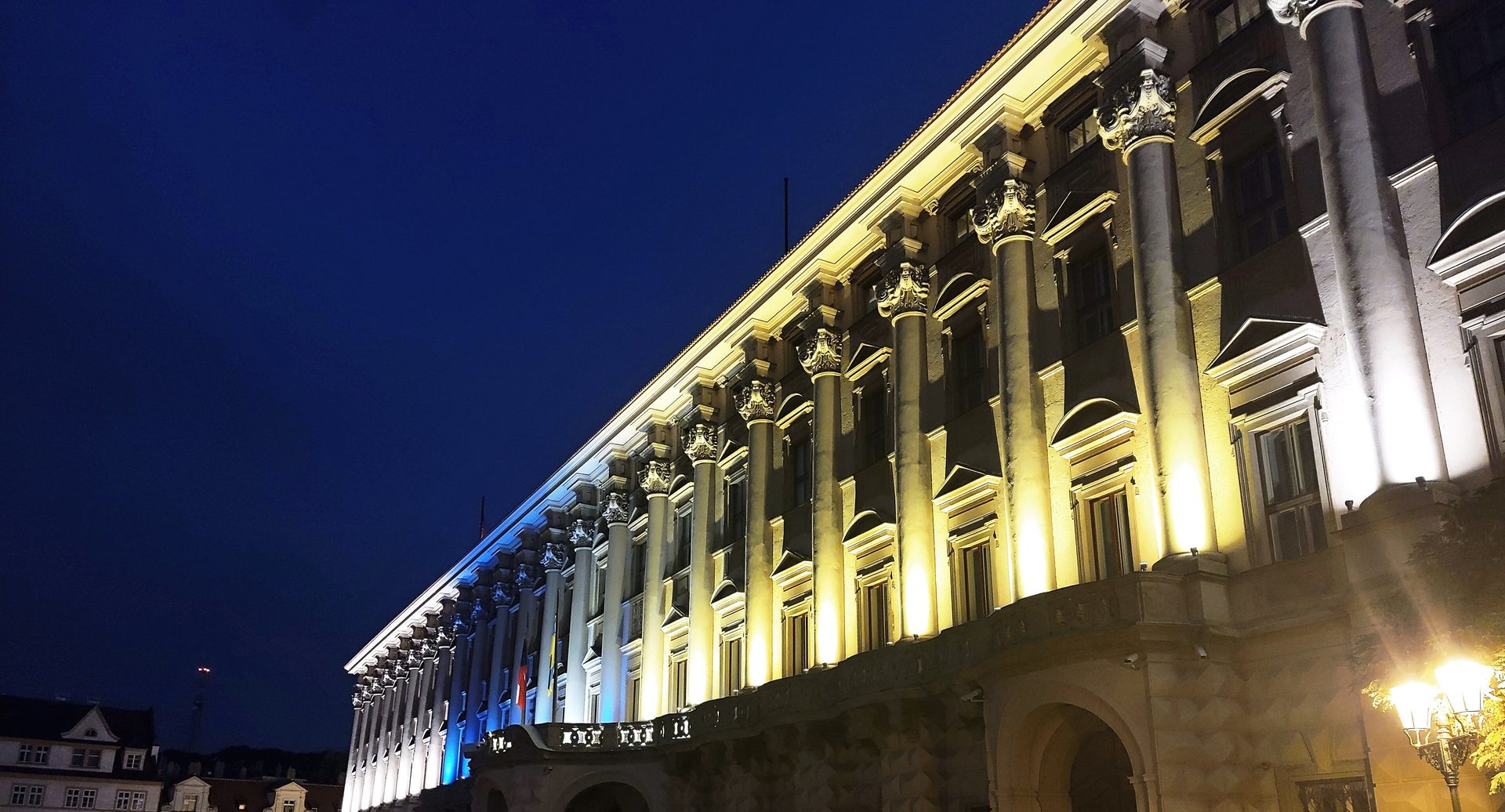
Before dawn on 10 March 1948, two stokers crossing the courtyard of the Czernin Palace in Prague found the foreign minister, Jan Masaryk, barefoot and in pyjamas on the paving under his own bathroom window. By noon the radio had a word for it.
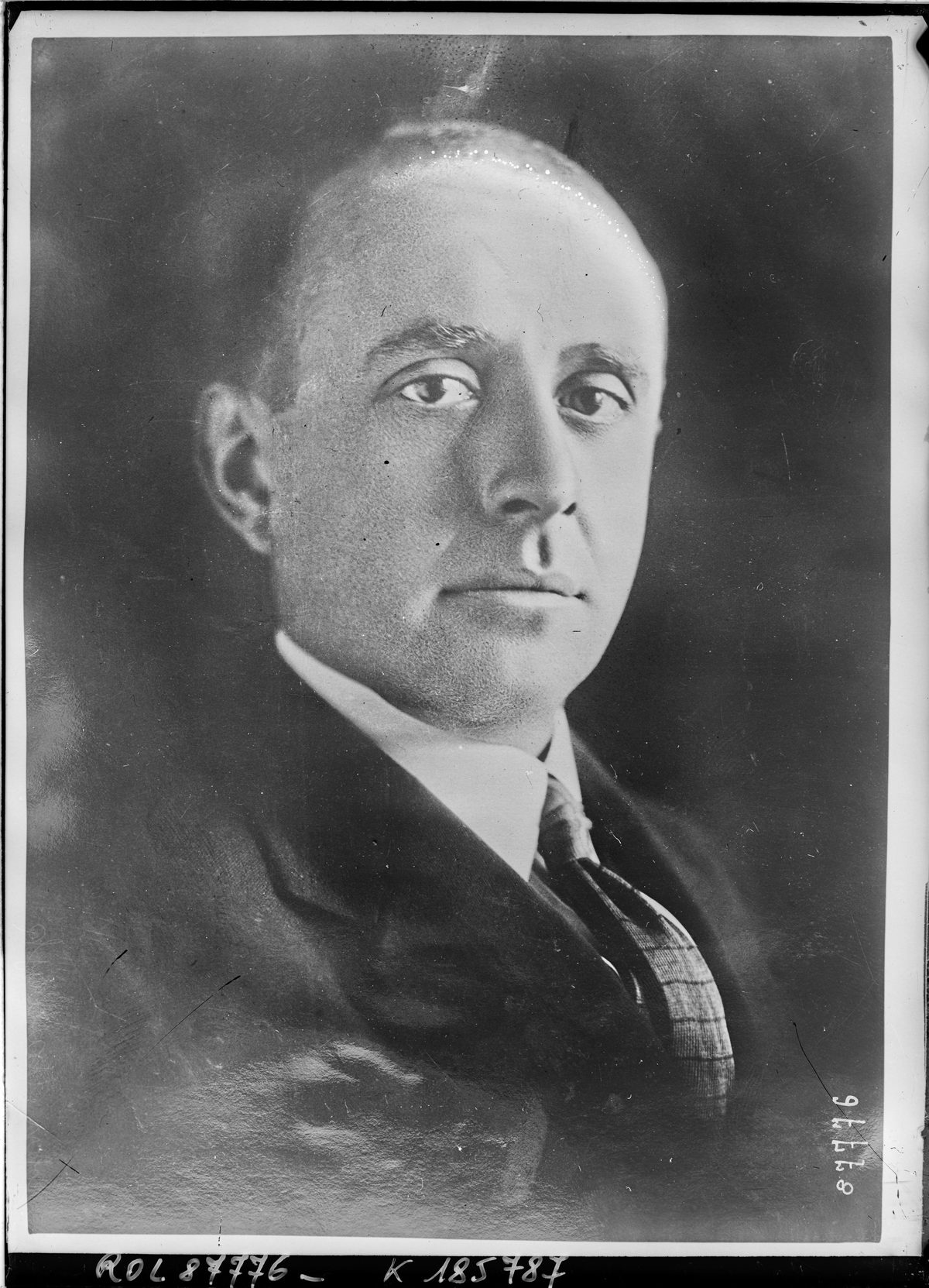
I went to Moscow as a free minister and I came back as Stalin's stable-boy.
Jan Masaryk in July 1947, as his secretary Jiří Špaček recalled it for Czechoslovak Television in 1968
Czernin Palace at night. Ladislav Boháč, CC BY-SA 4.0 (source)
The film
At a glance
- Period
- 1948 to 2026
- Countries
- Czechoslovakia (today Czech Republic), Soviet Union (today Russia), United Kingdom, United States
- Subject
- Jan Masaryk, foreign minister of Czechoslovakia
- Key locations
- Prague, Lány, Sezimovo Ústí, Moscow, London, Washington
- Themes
- Jan Masaryk, Czernin Palace, Prague 1948, communist coup, exhumation 2026, unsolved death
- Status
- A criminal inquiry on suspicion of murder has been open since 10 January 2025. The remains were exhumed on 2 September 2026 and the results of the examination are expected in several months. Status as the episode left it, 11 September 2026.
- Episode
- EF-019 · 36 min · published 11 September 2026
Case overview
Seventy-eight years later, on 2 September 2026, the police opened the family crypt at Lány and lifted him out. This is the file between those two mornings: the 1948 police photographs, the two typewriters on the autopsy papers, the witnesses Czechoslovak Television put on camera in 1968, the measurements of the cornice and the courtyard, a tape kept in a kitchen for fifty-one years, an American intelligence report that surfaced in 2024, and the six investigations that read the same room and reached four different answers.
The people who knew him best believed he jumped. The people who measured the courtyard concluded he did not. Between those two readings sit a window that opens outward, a bench, a cornice, a smear on a sooty board, two typewriters, a tape in a kitchen, an American report, and a body that a crypt kept intact for seventy-eight years and that still cannot say whether a hand was on it. The window is still there, in the wing above the second courtyard, and it still reads two ways.
Timeline
Jan Masaryk was born in Prague in 1886, the son of the professor who founded Czechoslovakia in 1918 and was its president for seventeen years.
The son failed at school, was sent to America at twenty, and served in the Austrian army in the war his father spent building a country against Austria.
From 1925 he was his country's envoy in London, and from 1940 the foreign minister of its government in exile.
Czechs at home risked their lives to hear his wartime broadcasts on the BBC. The country called him Honza, the pet form of his name, as you would a friend.
In July 1947 the Soviet Union summoned the Czechoslovak government to Moscow over the Marshall Plan, and Stalin told the delegation that going to Paris would be an act against the Soviet Union.
Masaryk's secretary Jiří Špaček met him at the Prague airfield when he came back, and told Czechoslovak Television twenty years later what the minister said as they walked from the plane: "I went to Moscow as a free minister and I came back as Stalin's stable-boy." He added: "Remember that date."
In February 1948 the communists took the country in ten days. Twelve non-communist ministers resigned on the twentieth of February to force an election. Masaryk did not resign.
On the twenty-fifth the president, Edvard Beneš, gave in and appointed the government the communists wanted, with Masaryk still at the foreign ministry, the one name that made it look like a coalition.
Two Western ambassadors saw him on the same afternoon. The American, Laurence Steinhardt, cabled Washington that Masaryk had tears in his eyes and said he had already saved about two hundred and fifty people by staying.
The British ambassador, Pierson Dixon, wrote to London that Masaryk was pathetic and at one point broke down, "or put on an act of breaking down", that he had saved about fifty people, that he would have been arrested at once had he resigned, and that "he did not hanker after a martyr's crown". A historian printed Dixon's telegram in 1983. Its last line reads: "My guess is that he will not be with us long."
Related documentsThe seventh of March was a Sunday and the ninety-eighth anniversary of his father's birth. On the Old Town Square the party's speakers told the crowd that if Tomáš Masaryk were alive he would approve of everything, including that his son sat in the government.
One of Masaryk's secretaries told Czechoslovak Television in 1968 that the minister came back to his office that day more indignant than he had ever seen him, and then looked up and asked: "What do you think, would it have any meaning if I did away with myself? Would people understand it?" That Sunday morning Davenport flew to London. He had told her he would follow in a few days.
On the morning of the ninth of March he drove south to Sezimovo Ústí, the president's country villa in south Bohemia, where Beneš was receiving the new Polish ambassador. A newsreel camera was there. It filmed the villa, the Polish flag beside the Czechoslovak one, the salon, and Masaryk laughing in an armchair. It is the last film of him alive.
He stayed for lunch and walked with the president in the garden. On the road back he fell asleep in the car. The bodyguard, Vilém Vyšín, said on camera in 1968 that in five years of driving with him that had never happened once. Dinner was at eight: cold chicken and compote, a beer and mineral water, brought by the household manager, Václav Topinka, and the valet, Bohumil Příhoda. By half past nine the staff had gone, with the order to wake him at half past eight.
Related documentsBefore dawn on the tenth of March 1948, two stokers came down from the attic of the Czernin Palace in Prague, the baroque palace on the hill that houses the foreign ministry. On the way back across the courtyard they found a man on the paving. He was barefoot, in pyjamas, lying on his left side about three metres out from the wall. Some fourteen metres above him a bathroom window stood open.
By two minutes past twelve the radio had a word for it. By three minutes past two the minister of the interior had used the word in parliament. By three o'clock the pathologist had begun. At twenty to eight the minister of the interior, Václav Nosek, arrived and stopped the examination over the doctor's protest. At about eight, on Nosek's order, Dr Jan Hora of the State Security, the communist secret police, took the case, and the criminal police, in Borkovec's words twenty years later, cleared the field.
Related documentsOn Saturday the thirteenth of March, at the family grave in Lány, west of Prague, the new foreign minister, Vladimír Clementis, said: "May the native earth that covers father, mother and son lie light on you, Jan."
Related documentsHájek's signed protocol lists a ruptured heart, tears in the liver and the spleen, broken ribs, a broken spine and a shattered pelvis, and says death was instantaneous. It never uses the word suicide.
The stomach reached the chemist six days later, cut open and empty. His report is dated the nineteenth of April, six weeks after the death, and finds traces of one or two sleeping tablets and nothing else. Only after that did someone type a final opinion beneath the pathologist's findings, on a different typewriter, saying that nothing contradicted suicide. No signature. By then the state had buried him.
Related documentsA statement in Dr Teplý's name reached the Czechoslovak exile in New York in 1951 and was published there by a New York Times editor. In it the doctor says he was called before five, that he found a small hole behind the ear, that in front of the security men he said only that the autopsy would settle it, and that the shattered heels looked to him like the work of a hammer.
Dr Teplý, the police doctor, died on the fourth of January 1949, ten months after the minister, suddenly and, in the police volume's words, allegedly by his own hand. He also set down his own reading of the night, and it belongs to no camp. He called it a forced suicide: a man in terrible fear, alone in a lit room, whom the banging of a door could have sent out of the window.
On the seventh of April 1965 the German magazine Der Spiegel printed a piece under the byline Michael Rand, titled "Five men came after midnight". It claimed to rest on sworn statements by seventy policemen from the secret files of the Prague interior ministry, and it gave five men in the palace, a puncture behind the right ear, and a bunch of violets in the coffin to hide it.
It named a deputy security chief called František Borkovec who had been hanged for the case. No such man existed.
Related documentsOn the third of April the philosopher Ivan Sviták published an open letter in the student paper listing fourteen points that did not fit a suicide, and the same day the office of the Prosecutor General, the country's chief prosecutor, gave the case to Dr Jiří Kotlář.
In April alone the Czechoslovak press printed a hundred and fifty-four pieces on the death, five a day. On the sixth of April a Bratislava paper printed the night clerk's story. Czechoslovak Television made a four-part series called In Aid of the Prosecutor General, and put the household in front of the camera.
Related documentsOn the thirtieth of April 1968 the secret-police inspector who had been first at the scene, Vilibald Hofmann, walked out of his interrogation at the prosecutor's office and into the kitchen of a family named Grulich in Karviná, and they switched on a tape recorder.
He said the photograph the police had shown him was not the original picture, that the dead man had been arranged. He said the stokers had gone up before half past four. He said Dr Teplý had told Hora that death was four to six hours old, which would put it around midnight. The family kept the tape for fifty-one years.
An American reporter, Claire Sterling, had been in Prague through the inquiry, and in November 1969 she published the book that made the case in English. She concluded, in her words, that Jan Masaryk was murdered, although it wasn't a perfect crime.
The Central Intelligence Agency had read the proofs three months earlier, and its confidential memorandum sits in the released files today. It says the documentation falls short, that the author's inability to identify Soviets is a disappointment, that she has apparently been fed, possibly in good faith, information of doubtful validity, and that the book will keep the pressure up.
Related documentsOn the twenty-first of August the tanks came. Kotlář was removed in October 1969, and on the tenth of November the prosecutor's office shelved the case with a finding that Masaryk had undoubtedly sat in the window to cope with insomnia, that suicide and accident had equal support in the traces, and that murder was safely excluded.
In June Kotlář told the press that of the three versions, murder, suicide or accident, none could be preferred and none entirely ruled out, and that he was not considering opening the grave: there were no legal grounds, and there was the question of respect for the dead.
Related documentsAfter 1989 the file went to the police office that investigates the crimes of the communist years, the ÚDV. In 1993 its investigator Jan Havel measured the room. The bathroom window is a metre and a quarter wide and a little over a metre high, with its sill a metre and ten above the floor and a fixed bench beneath it. One floor below the window a stone cornice sixty centimetres deep runs the length of the facade. The paving is some fourteen metres down.
The police sketch of 1948 puts the point of impact two metres twenty from the wall and the body two metres ninety out, thirteen metres ten from the side wall. Havel's picture of the night was a search party in the flat, the minister out through the window onto the cornice, a lost footing in the dark, a last push off, and a landing on both feet.
Related documentsMoscow never answered a single Czech request. On the twenty-seventh of November 1996 the case was shelved again.
In 1993 a man in Moscow had telephoned Radio Free Europe to say that his mother, a former NKVD colonel who had served in Prague, knew the names of the men who had done it.
On the twenty-second of December 2003 the ÚDV closed the case with the finding that Jan Masaryk had been murdered in his service flat by unknown perpetrators, and shelved it because there was no one left to charge.
In 2001 the office opened it once more and asked a biomechanic, Professor Jiří Straus, to compute the fall. His finding was that to land where the body lay, the fall had been accelerated by an external force of between eleven hundred and twenty-three hundred newtons at the centre of gravity, and that someone else had pushed him. Two other experts in the same file, Porada and Vémola, answered that the same distance needed no external force and that an active jump was acceptable. On the thirtieth of January 2003 the Russian prosecutor's office replied that the witness in Moscow had died and the archives stayed closed.
Related documentsIn July 2019 the tape reached a researcher, Václava Jandečková, and in October Czech Radio broadcast it. The supervising prosecutor, Michal Muravský, ordered a new investigation.
Two engineers in Plzeň modelled the fall from fourteen metres thirty and found that no external force was needed and that all three versions were physically possible. Their court expert, Jan Špička, put it this way: a limp body thrown from the window was unrealistic with a probability bordering on certainty, but a push from the cornice needing only a small force could not be excluded.
Related documentsOn the fifth of March 2021 the case was shelved for the fourth time. Muravský's sentence was that the active participation of another person in the fall could be neither confirmed nor refuted.
Jandečková called it a farce. She had asked the minister's great-niece, Charlotta Kotíková, for the family's consent to open the grave, and had not received it.
Pavel Žáček, a historian in parliament, had pressed for years for the foreign archives, and in 2024 the foreign minister asked London, Paris and Washington through the embassies. By August about a hundred and fifty pages had arrived. Among them was a report written by an American military-intelligence officer in Prague in the days after the death.
His source had spoken with the valet on the twelfth of March. In that account three men the valet did not know arrived at half past eight on the evening of the ninth, four black coffees were ordered an hour later, and at about ten the valet was woken by the minister shouting: "I will not do this for you. I will sign everything, but not this. I will do everything, but this can happen only over my dead body." To the Czechoslovak police, in 1948, the same valet said that after dinner nobody came.
A murder inquiry is opened
On the tenth of January 2025 the ÚDV opened a criminal inquiry on suspicion of murder, with a team of three investigators and two researchers, one of them the former head of what Prague calls the murder squad. The record cited the newly obtained documents.
On Wednesday the second of September, before six in the morning, the mayor of Lány handed the cemetery keys to the police. The cemetery and its car park were closed for two days, officers stood along the white wall, and the small village graveyard was ringed with cars.
A police spokesman, Jakub Vinčálek, read a statement at the gate: they were carrying out steps of criminal proceedings consisting of the exhumation of the remains and their examination by the most modern criminalistic methods, and they believed the day's steps would bring them closer to clarifying the circumstances. In 1968 the prosecutor Kotlář had refused to open this grave out of respect for the dead.
Related documentsOn the fourth of September the forensic doctor who took part, Jiří Hladík, said on Czech Television that the body had turned waxy in the crypt, which had preserved it, and that the skin had been broken only by the autopsy cut of 1948. A sharp object, a firearm, a blow to the head would have been visible. Nothing of the kind.
Then he said the sentence the case has been waiting on since the morning it began: "If someone pushes you, how do you prove it?" The experts moved on to the bones. The results are expected in several months.
Key locations
Full mapDocuments and evidence
Sources
- Book
Jan Masaryk (úvahy o jeho smrti) ÚDV, Prague; ISBN 80-86621-10-3, 2005.
The police volume on the case. Later writers strung these deaths into one chain. One telling counts twenty dead in ten years. The police volume on the case dates each of them and stops there.
- Book
The Masaryk Case Harper & Row, New York, 1969.
An American reporter, Claire Sterling, had been in Prague through the inquiry, and in November 1969 she published the book that made the case in English. She concluded, in her words, that Jan Masaryk was murdered, although it wasn't a perfect crime.
- Book
Too Strong for Fantasy New York, 1967.
In her memoir, published in 1967, she wrote that he said many times, in a careless tone, "One day they'll kill me."
- Book
Kauza Jan Masaryk (nový pohled): Doznání k vraždě a tajný přešetřovací proces StB z let 1950-1951 2015.
A researcher in 2015 read the confession as real, and a journalist who ran his own experiments in the window called it nonsense from beginning to end.
- Academic
Jan Masaryk Twelve Days before His Death The Slavonic and East European Review, vol. 61, no. 2 (April 1983), pp. 252 to 253, 1983.
A historian printed Dixon's telegram in 1983. Its last line reads: "My guess is that he will not be with us long."
- Archive
Stenographic record of the National Assembly, 10 March 1948 Digital Repository of the Chamber of Deputies of the Czech Parliament (psp.cz), 10 March 1948.
At three minutes past two Nosek stood up in parliament and said that Jan Masaryk had voluntarily ended his life, that in his own nation he had no enemies, and that the telegrams from the West had driven him to it.
- Archive
Foreign Relations of the United States, 1948, volume IV: the Czechoslovakia chapter Office of the Historian, US Department of State (history.state.gov), 1948.
The American ambassador's telegrams of March and April 1948, as printed in the State Department's published record.
- Archive
CIA Records Search Tool (CREST): documents on the Masaryk case, released 2004 to 2013 Central Intelligence Agency.
The Central Intelligence Agency had read the proofs three months earlier, and its confidential memorandum sits in the released files today.
- Archive
Period press pages, 1948 to 1969 Arcanum Digitheca (ADT) and the Blinken OSA Archivum collections.
In April alone the Czechoslovak press printed a hundred and fifty-four pieces on the death, five a day.
- Newspaper
Nová svoboda 11 March 1948.
"Jan Masaryk dead": the report of the morning after.
- Newspaper
Mladá fronta November 1948.
The Choc trial. A student named Miloslav Choc was tried for it, and told the court more than once that Schramm had murdered Jan Masaryk.
- Newspaper
Der Spiegel: "Five men came after midnight" (Michael Rand) 7 April 1965.
It claimed to rest on sworn statements by seventy policemen from the secret files of the Prague interior ministry, and it gave five men in the palace, a puncture behind the right ear, and a bunch of violets in the coffin to hide it.
- Newspaper
Student: Ivan Sviták's open letter 3 April 1968.
On the third of April the philosopher Ivan Sviták published an open letter in the student paper listing fourteen points that did not fit a suicide.
- Newspaper
Smena: "Who is Pavel Straka" 6 April 1968.
On the sixth of April a Bratislava paper printed the night clerk's story.
- Newspaper
Mladá fronta: "How did Jan Masaryk really die?" 7 April 1968.
- Newspaper
Zemědělské noviny: the prosecutor Kotlář 9 April 1968.
- Newspaper
Lidová demokracie: the head of the Prague criminal police in 1948 speaks 11 April 1968.
At ten past seven the head of the Prague criminal police arrived, Dr Zdeněk Borkovec, the same detective who had chased the Vranská suitcase murders in 1933.
- Newspaper
Mladá fronta: the prosecutor's press conference June 1968.
In June Kotlář told the press that of the three versions, murder, suicide or accident, none could be preferred and none entirely ruled out, and that he was not considering opening the grave: there were no legal grounds, and there was the question of respect for the dead.
- Newspaper
Nová svoboda: the reversal 27 September 1969.
A party paper revealed that the Spiegel author had been paid a thousand dollars, roughly ten thousand today.
- Documentary
Na pomoc generální prokuratuře (In Aid of the Prosecutor General), four parts via the CS Dokumenty re-upload on YouTube, 1968.
Czechoslovak Television made a four-part series called In Aid of the Prosecutor General, and put the household in front of the camera.
- Documentary
Czechoslovak newsreel, 9 March 1948 (Sezimovo Ústí) 9 March 1948.
A newsreel camera was there. It filmed the villa, the Polish flag beside the Czechoslovak one, the salon, and Masaryk laughing in an armchair. It is the last film of him alive.
- Documentary
Masaryk Decides 1948.
- Documentary
- Documentary
Jan Masaryk's Funeral 1948.
- Documentary
Masaryk Funeral 1948.
- Documentary
- Web
Upravené fotografie těla i jiná hodina smrti. Unikátní nahrávka přináší nové informace ke smrti Jana Masaryka 2 October 2019.
In July 2019 the tape reached a researcher, Václava Jandečková, and in October Czech Radio broadcast it.
- Web
iROZHLAS.cz, 22 August 2024: the Western documents and the three visitors 22 August 2024.
By August about a hundred and fifty pages had arrived. Among them was a report written by an American military-intelligence officer in Prague in the days after the death.
- Web
- Web
ČT24, 28 January 2025: the police open the case on suspicion of murder 28 January 2025.
On the tenth of January 2025 the ÚDV opened a criminal inquiry on suspicion of murder, with a team of three investigators and two researchers, one of them the former head of what Prague calls the murder squad.
- Web
Poslední šance objasnit smrt Jana Masaryka: Kdo ji chce promarnit 4 February 2025.
- Web
Jak zemřel Jan Masaryk? Experti exhumují po téměř 80 letech jeho ostatky z rodinné hrobky 28 August 2026.
On the twenty-eighth of August 2026 Czech Radio reported that the police would open the grave.
- Web
ČT24, 2 September 2026: the experts exhume Jan Masaryk's remains 2 September 2026.
- Web
iROZHLAS.cz, 2 September 2026: the exhumation at Lány 2 September 2026.
What remains unresolved
- Did he jump, did he fall, or was he put there?
- Why can a country with the whole file in its hands still not say?
- Which way does the room read to you, and what in this file made you decide?
Related files
 Unsolved for 90 Years: The Girl in Two SuitcasesThe same detective and the same pathologist: Dr Zdeněk Borkovec and Professor František Hájek worked the Vranská case in 1933.
 The City That Stopped Opening Its Doors: The Mosgaz Panic of 1963Also in Moscow
 He Was in a Cell When the Shots Were Fired: The Babice CaseAlso in Prague
 Yugoslavia Sent a Hitman to Scotland. A Neighbour's Envelope Beat HimAlso in London