Case fileEF-015Kirkcaldy, 1988
Yugoslavia Sent a Hitman to Scotland. A Neighbour's Envelope Beat Him
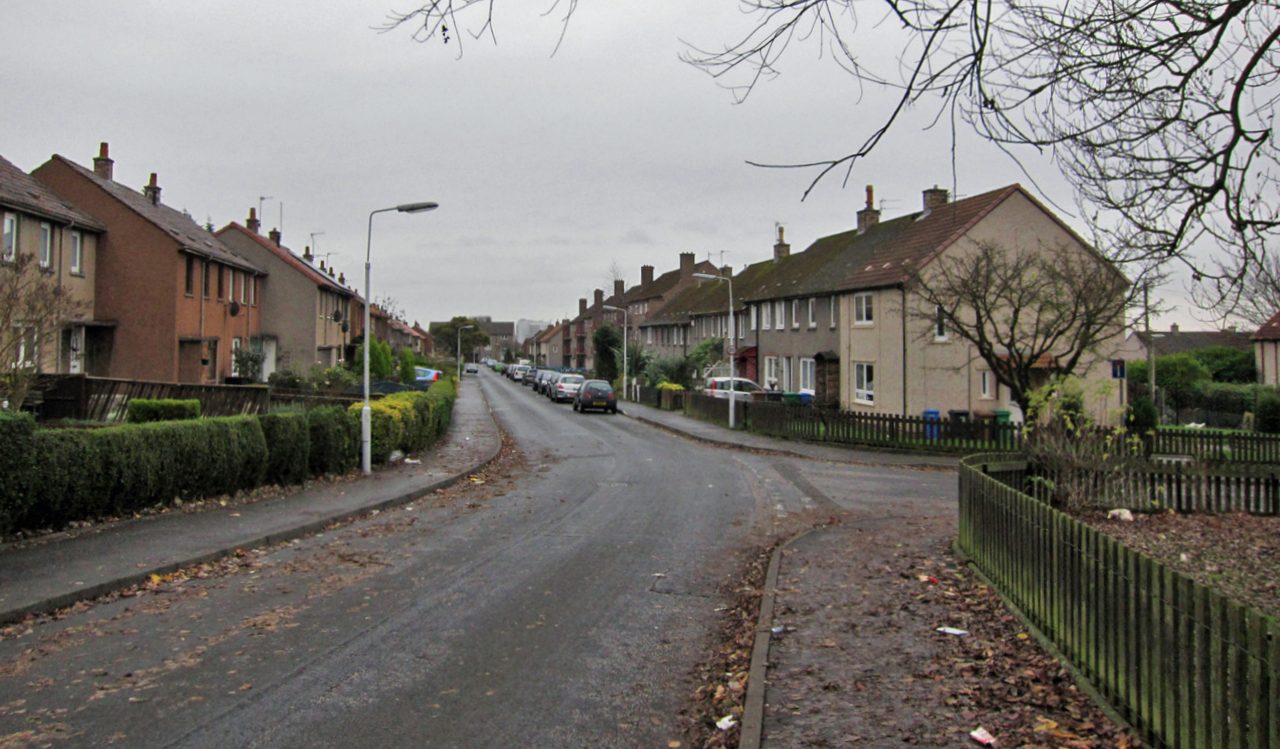
On a quiet street in Kirkcaldy, Scotland, on an October morning in 1988, a man walking his Alsatian home from the woods bent down to help a driver who seemed to want directions. The driver's hand came up holding a silenced pistol, and it kept firing until it was empty.
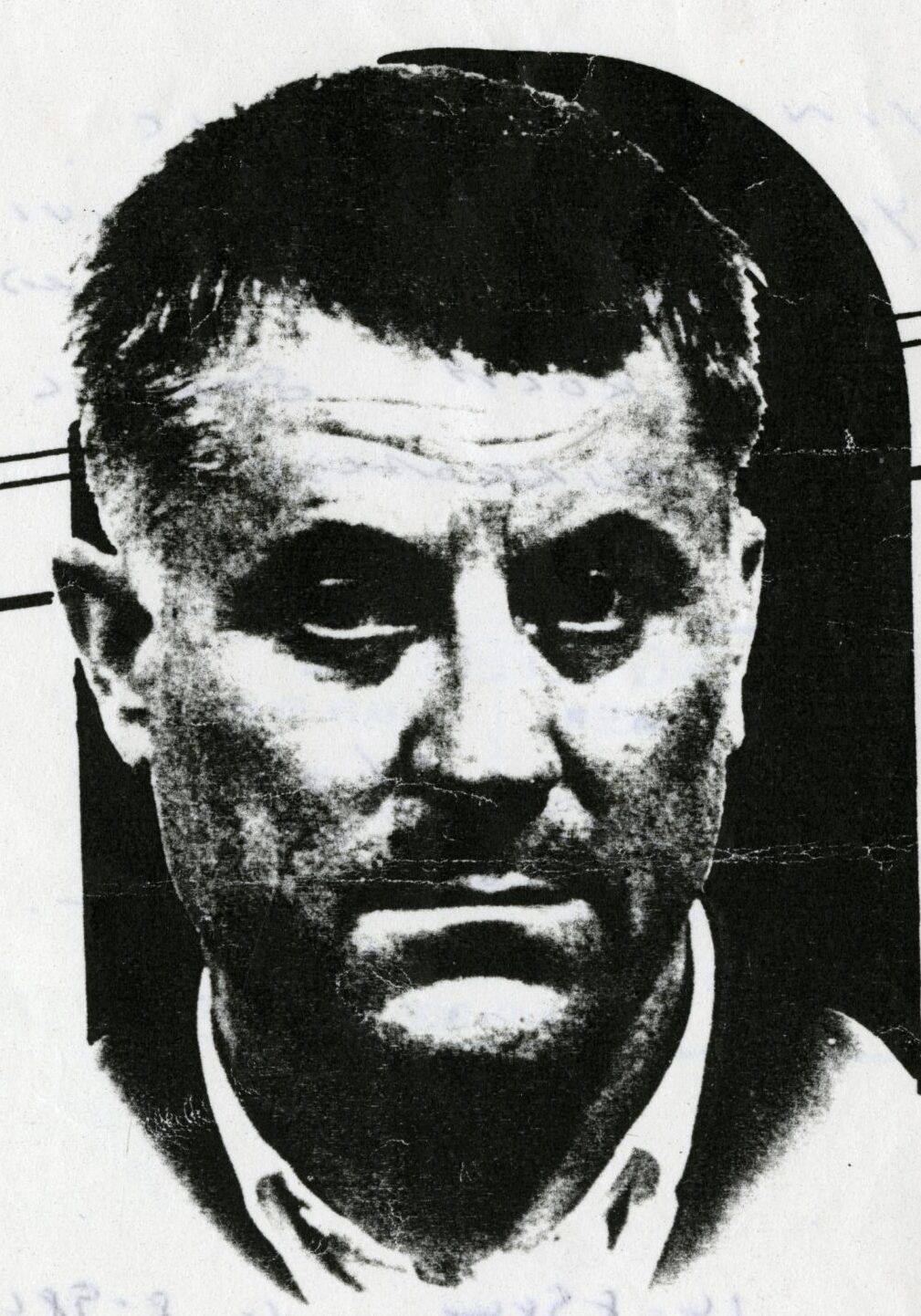
I do not think I have any personal feelings toward the person himself. I see a machine that operates in a certain way, terrorising the political opposition. He is just one cog in the machinery that carries out murders.
Nikola Stedul on the courthouse steps at Dunfermline, May 1989
A street in the Templehall district of Kirkcaldy. Richard Dorrell, CC BY-SA 2.0 (source)
The film
At a glance
- Period
- 1937 to 2026
- Countries
- United Kingdom, Yugoslavia (today Croatia), Croatia, Germany, France
- Subject
- Vinko Sindicic, the man Yugoslavia's secret police sent to Kirkcaldy
- Key locations
- Kirkcaldy, London, Dunfermline, Perth, Rijeka, Zagreb, Munich, Paris
- Themes
- true crime, cold war, yugoslavia, kirkcaldy, udba, vinko sindicic
- Status
- The court in Rijeka has not answered the bid by Josip Perkovic and Zdravko Mustac to take over the prosecution of Vinko Sindicic themselves. In Britain, one closed extract of thirty-six pages stays sealed until 2071. Status as the episode left it, 4 September 2026.
- Episode
- EF-015 · 60 min · published 4 September 2026
Case overview
That evening, Metropolitan Police officers were waiting at a Heathrow departure gate for a passenger travelling on another man's passport. A few hours earlier, he had refused to leave Scotland without his twenty pound car-hire deposit.
This is the full story of the day the Cold War came to a Scottish cul-de-sac: the exile Yugoslavia's secret police had followed for a decade, the neighbour's envelope that put a name to the man in the hire car, and the trial at Dunfermline that made him the only officer of that service any court ever held for its work abroad.
The man who shot him is free, in the Italian sun, at eighty-two. The generals he accused are in prison for a different murder, and spent this past year trying to prosecute him for lying about them, while the state stood aside, saying it cannot prove he lied. Somewhere in London sit thirty-six sealed pages that will stay sealed until 2071.
Timeline
Stedul was born in 1937 in a village near Karlovac, in what was then becoming communist Yugoslavia.
When the Second World War ended, the new state settled its accounts, and his family would learn that his brother Petar was among the thousands taken north and killed in the mountain reprisals, his body never returned. Nikola grew up, was called up, and understood what the state expected of a border guard. He refused, in his own later words, to stand on the border and shoot people trying to escape.
It begins on the island of Krk, where Vinko Sindicic was born in September 1943, into a poor family, in the middle of a war.
He trained as a hotelier in Opatija, and in 1964, facing the draft, he left the country the coastal way: off a ship in Venice. By Christmas Eve 1964 he was in Frankfurt, working under a borrowed Italian identity, eight days hungry at one point, helped along, he said, by a priest who turned out to be from Sarajevo.
In 1967 he walked into the Yugoslav Military Mission in West Berlin and handed those files over. Nobody recruited him. He offered.
He became personal secretary to dr. Branko Jelic, one of the most prominent exile leaders in Europe, with access to his files, his letters, his membership lists.
In the Croatian State Archives, and reproduced in print, is the report of the Rijeka office of the secret police, dated the fifth of April 1968, on the recruitment of Vinko Sindicic.
The officers noted their new man was very bright, decisive, quick to react, good in Italian and German. In further correspondence, the report says, we will run him under the pseudonym Miso. By May 1969, the tasking on paper was to study all possibilities of an offensive action against dr. Jelic, an action, the document specifies, in which Miso personally and alone would take part, all the more since Miso already now absolutely accepts such a solution.
Related documentsThe Brotherhood leased a motel near Heidelberg as a safe house. The lease was signed in the name of a German woman named Elke. Elke was Vinko Sindicic's wife. In the night of the ninth to the tenth of March 1972, Josip Senic was killed in that motel.
German police suspected Sindicic; he was never charged, and he has always denied it.
Related documentsIn August 1972 Sindicic travelled south with Sevo, Sevo's wife Tatjana, and her nine-year-old daughter Rosemarie, sharing the road on what the family thought was a holiday drive. On the twenty-fourth of August, near Venice, all three of them, the man, his wife, and the child, were found shot dead in their car.
Sindicic was elsewhere by then, and surfaced across the border in Rijeka. Italian investigators asked Yugoslavia for permission to question him. Yugoslavia refused, and never gave him up. He was never charged, and he has always denied this too, insisting decades later that he had said goodbye to the family at a train station and that these are the truths.
Related documentsIn 1973 they sold the farm and left for Europe to visit his widowed mother. They never made it back. When his Australian passport came up for renewal in 1974, the renewal never came.
Australia's security service had been interviewing him for years, and after emigre delegates elected him president of a worldwide movement, a tribunal in Canberra put its reasoning on paper: there was a real risk, it said, that with a passport he would travel abroad to plan violent subversion in Yugoslavia. Stranded in Europe with an expiring passport, the Steduls used it one last time, to reach Shirley's home town. The people of Kirkcaldy, he said, overwhelmed them with friendliness. They stayed.
The port housing office in Rijeka issued a flat at Mihanoviceva 40c to a tenant named Ante Morovic; the contract survives in facsimile. Ante Morovic had Sindicic's face, a new codename in the files, Pitagora, and soon a restaurant, called Stara Vrata, on the ground floor of a state shipping agency's headquarters.
On the thirteenth of May 1975, the holiday the regime celebrated as State Security Day, the federal interior minister of Yugoslavia, Franjo Herljevic, presented him with a gold watch, engraved with a dedication from the federal ministry in Belgrade.
Related documentsIn October 1978, the most famous Croatian emigre in Europe, a journalist named Bruno Busic, was shot dead late in the evening on a Paris street, returning to his flat.
France investigated, closed the file in 1982, and to this day no French court has named a killer. Years later, under oath in Zagreb, Sindicic himself would testify that weeks before Paris he had been sent to London with another man to kill Busic there, and that he, by his own account, sabotaged the plan and sent his partner home.
Related documentsOn the Saturday evening before the shooting, a man walked up to the Avis car hire desk at Edinburgh Airport and hired a small black Mini Metro with a red stripe. He showed a Swiss passport and a driving licence in the name Rudolf Lehotzky, and he did something rental clerks remember: he paid in cash.
On the Wednesday morning, a postal officer named Eric Martin came out in the early dark and caught the car in his headlights, parked beside his daughter's, with a man inside who ducked out of sight and then drove off. Martin had been reading his local paper, the Fife Free Press, which that autumn was full of a spate of break-ins. So he did what a careful man does about burglars. He took an envelope and wrote down the registration number.
Related documentsOn the twentieth of the month, at about a quarter past eight in the morning, a fifty-one-year-old man was walking his Alsatian home from the woods, the same route as every morning, and had come within two doors of his own front gate. A black car rolled down the road toward him. It slowed. It stopped at the kerb beside him, and the driver leaned across the passenger seat as if he wanted to ask directions. The man bent down to help.
The first two rounds had hit Stedul in the face: one full in the mouth, shattering his teeth and tearing through toward the back of his neck, the other just above his lip. More rounds hit his body as he lay there, one lodging close to his spine, one passing through his thigh, one grazing his arm. At the old Royal Infirmary in Edinburgh they transfused him with warmed whole blood to hold off shock, and counted themselves, in their own word, witnesses to a miracle.
Related documentsThat evening, at a gate at Heathrow, Metropolitan Police officers arrested a man whose passport said Rudolf Lehotzky. There was a real Rudolf Lehotzky. His passport had vanished from a Zagreb hotel a few weeks earlier.
Eric Martin's envelope went to the Police National Computer; the number came back as an Avis hire to a Rudolf Lehotzky; and Avis could add one more thing: the gentleman had just flown to London. When the shuttle emptied at Heathrow, the Metropolitan Police were at the gate.
Related documentsThe next morning, two council workmen clearing a verge on the road toward Dunfermline picked up a small black bag with a gun, a long silencer and a magazine in it, and a lorry driver stopped for a bag that looked too good to throw away, and found a second pistol, a second silencer, and more ammunition.
Two guns, for one gunman, is a detail worth keeping in your pocket. Scottish reporting later added another: by one account the weapons had never crossed a border at all, but had been collected from a hide in a wooded area near the town.
Related documentsThe trial opened in the spring of 1989, before the High Court sitting at Dunfermline, twelve miles from the street where it happened, under the tightest security Scotland had seen. It lasted eleven days, and it was, among other things, a parade of collapsing stories.
The accused said he had come to Scotland to ask Mr Stedul for help, and had been near Glen Lyon Road on earlier days but never quite got as far as making contact. As to the morning itself, he had an alibi: at the moment of the shooting he had been on the phone to Yugoslavia. His sister, his mistress and a friend all flew in to swear to it. The jury also heard that firearms residue had been found on his skin.
Related documentsThe jury of eight men and seven women went out for almost three hours, asked to look again at the Metro and at the gun, and came back with guilty on the most serious charge by majority, and guilty on all eight charges he faced.
Lord Allanbridge told him: you have been convicted of a cold-blooded offence. This was a callous, calculated and carefully planned attempt to kill Mr Stedul, and Mr Stedul is very fortunate to be alive today. Fifteen years for the attempted murder; the firearms counts ran alongside, concurrent. When it was over, police officers in the courtroom shook Stedul's hand and kissed his wife. The family had spent six months in protective custody.
Related documentsThe first message, Vukusic writes, reached the Scottish prison in December 1992, carried in by Sindicic's common-law wife, from Josip Perkovic, the secret police general who had run him, writing under the cover name he had used for the Scotland job: Boris Horvat.
Its content was a script. Deny everything. Explain your contacts as chance acquaintances. The essential thing, it said, is to stay silent, to endure, even when it seems everything is known. And then the line that turns a coaching note into a contract: as for the thing up there, when it comes, nothing. The family will collect it, and it will be OK.
Related documentsIn August 1996 he wrote to Boris Horvat: first you must settle my claims, as is due to me by law and by morality, in foreign currency, into a German bank, in my wife's name.
And do not get any of your stupid ideas about solving this problem some alternative way. Be polite, and look after your health. You know that I know everything.
Related documentsIn January 1998 came a formal notice of default, fifteen days to pay, routed, Vukusic writes, through the office of the President of Croatia itself: fail to settle the debt in full and on time, it says, and I will be compelled to take you to court here to enforce it.
The service had never paid him for Kirkcaldy. He had been arrested before the fee cleared, his restaurant was gone, ten years of his life were going with it, and the hitman was dunning his spymaster like an unpaid roofer.
Related documentsIn the last days of August 1998, with extradition to Croatia looming, the prisoner of Perth wrote two letters in one week. One went to President Franjo Tudjman, in English, naming the two most senior secret police men of the old Croatian service, Zdravko Mustac and Josip Perkovic, as the men, he wrote, who were behind the order because of which I found myself in Scotland, and telling the president to his face: it is your stable the stench spreads from.
The other went to the Consulate General of Germany in Edinburgh, under the subject line: preferment of criminal charges against Zdravko Mustac and Josip Perkovic, in connection with the murder of Bruno Busic in Paris. The German federal registry stamped it on the ninth of September 1998. Sixteen years later, that letter would be read aloud in a Munich courtroom.
Related documentsOn the sixteenth of November 1998, late in the evening, Britain handed Vinko Sindicic over to Croatia.
Croatian press photographers caught the arrival: the prisoner of Perth coming down the aircraft steps in handcuffs, a justice-police officer at each side. Croatian memory would dress the homecoming up later, a white suit, a bow tie, a satisfied smile, but the camera saw a man in a tan jacket being led down the stairs, and his first address in free Croatia was a remand cell.
Related documentsWhen the trial opened in Zagreb in November 1999, something happened that even seasoned court reporters found astonishing. The former secret police officers who, in the early nineties, had told investigators exactly who killed Bruno Busic, took the stand one after another and no longer remembered. Every last one of them changed his statement, wrote Vukusic, who sat through it; they suddenly lost their memory.
In March 2000 the court acquitted him, not proven, and five years later the Supreme Court made the acquittal final. Even Vukusic, no friend of the defendant, conceded on the page that objectively, no irrefutable proof had been produced. No one else was ever tried for Bruno Busic, before or since. The man Scotland convicted walked out of the Zagreb courtroom free, and prospered.
In 2008, at the trial of the mole Krunoslav Prates, Sindicic testified for days in flawless German. And the court believed him.
When it sentenced Prates to life, the Munich judgment spelled out, in writing, why the old hitman had turned: because Perkovic had abandoned him during and after the Scottish sentence, and had embezzled the assets entrusted to him in 1988. Had Perkovic proven cooperative, the court wrote, Sindicic would have had reason to go on protecting him.
Related documentsIn July 2016, before the Munich court trying the generals themselves, Josip Perkovic and Zdravko Mustac, he testified one more time: named two men as the Djurekovic shooters, one long dead, one living in Sweden and never tried, and told the court that thirteen thousand euros from Perkovic's side had bought one of his earlier retractions.
This court did not believe him. It said so, treated his evidence as unreliable, and then convicted Perkovic and Mustac anyway, on the documents and on the mole's paper trail, to life imprisonment, upheld on appeal in 2018.
Related documentsHe died at home in Zagreb on the fifteenth of March 2022, at eighty-four, just as, his daughter Monika wrote, the plum trees were bursting into blossom.
The day before he died, a letter had arrived at the Zagreb flat. It was from Vinko Sindicic. It demanded that Stedul publicly deny the assassination attempt, declare the whole thing a manipulation. His wife and daughters read it, looked at the man they had nearly lost to the sender thirty-four years earlier, and decided he would not spend an hour of whatever time remained on it. They never gave it to him.
Related documentsIn February, Serbian police arrested Sindicic in Belgrade on Croatia's old warrant for false testimony, and released him under travel measures. Three weeks later, Croatia's chief state attorney closed the twelve-year investigation with a sentence lawyers will be quoting for years: there was, the decision says, no evidence on which to conclude that his incriminating statements were false.
And two weeks after that, from their Croatian prison cells, Josip Perkovic and Zdravko Mustac, the generals serving life for the Djurekovic murder, filed to take over his prosecution personally, as private prosecutors: the convicted, prosecuting the witness, for lying about them. As of this summer, the court in Rijeka has not answered.
Key locations
Full mapDocuments and evidence
Sources
- Book
Zlocini komunisticke mafije Zagreb, 2013.
Years later the Croatian journalist Boze Vukusic, himself a veteran of the emigre movement, published it, letter by letter, facsimile by facsimile, and nobody involved has ever managed to make it go away.
- Archive
The files of Yugoslavia's State Security Service, Croatian State Archives
In the Croatian State Archives, and reproduced in print, is the report of the Rijeka office of the secret police, dated the fifth of April 1968, on the recruitment of Vinko Sindicic.
- Archive
The Munich judgments of 2008 and 2016 Higher Regional Court, Munich.
Munich in 2008 called his motive real and his account credible; Munich in 2016 called him unusable and convicted his generals without him.
- Archive
The Foreign Office files on the case, the National Archives at Kew
In Britain, the Foreign Office opened file after file on the case between 2021 and 2025, eight of them in the public catalogue now, and three still shut, one of them until 2044, and one closed extract, thirty-six pages, sealed until the year 2071.
- Archive
The official record of the House of Commons and the House of Lords
In the entire record of the House of Commons and the House of Lords, from that day to this, the names Stedul and Sindicic do not appear once.
- Documentary
ITN News at 5.45 ITN, 1989.
- Newspaper
The Glasgow Herald 1989.
- Newspaper
The Courier: Nikola Stedul assassination attempt saw bullets fly in Kirkcaldy DC Thomson, 19 February 2026.
The last trace of the man himself is a Scottish reporter's line from February 2026: the one-time hitman, it says, is living out his days quietly in Italy, at the age of eighty-two.
- Newspaper
The Scotsman: Assassination attempt pulled quiet Fife street into spy plot The Scotsman Publications, 2010.
A Scottish paper checked in on him in 2010 and found him working for a private security firm, giving newspaper interviews, and reportedly owning a fine house back in Rijeka with hair salons and a dry cleaner on the ground floor.
- Newspaper
Fife Free Press: The Kirkcaldy assassination attempt that shocked the nation Fife Free Press, via fifetoday.co.uk.
Martin had been reading his local paper, the Fife Free Press, which that autumn was full of a spate of break-ins.
- Newspaper
Nikola Stedul, the target of political assassination bid in Kirkcaldy, dies aged 84 Fife Today, 19 July 2022.
- Newspaper
Slobodna Dalmacija 17 July 2008.
When it sentenced Prates to life, the Munich judgment spelled out, in writing, why the old hitman had turned: because Perkovic had abandoned him during and after the Scottish sentence, and had embezzled the assets entrusted to him in 1988.
- Documentary
Goli zivot: Vinko Sindicic TV Happy, 28 March 2018.
In 2018 Serbian television sat him down for nearly three hours, one million views and counting, and he gave the performance of his life, denying everything with a showman's wink.
- Documentary
BUJICA: Nikola Stedul Osjecka TV, 8 July 2016.
In his last big television interview, in 2016, the host asked him for a closing thought: so, the old secret police still rules? Stedul answered with three words. So it seems.
- Documentary
- Documentary
The Croatian films on Bruno Busic, a 1992 documentary and a 2012 film
In October 1978, the most famous Croatian emigre in Europe, a journalist named Bruno Busic, was shot dead late in the evening on a Paris street, returning to his flat.
- Documentary
Crime Next Door: An Assassin Comes to Town BBC Sounds, 2024.
In 2024 the BBC gave it six podcast episodes. The reporter narrating them, Kaye Adams, had covered the Dunfermline verdict as a young journalist in 1989.
- Web
queens-enemy.com, the website of Vinko Sindicic
He kept a website, naturally, its name taken from that old Scottish prison classification he treasured, the Queen's Enemy, where he offered his memoirs for sale to the highest bidder.
What remains unresolved
- And Nikola Stedul, who had moved home to free Croatia in 1991 expecting justice to be a formality?
- So, the old secret police still rules?
- What do you think is on those pages?
Related files
 The Friend Held the Key: The Cold War Murder Germany Took 33 Years to SolveThe Munich cases over the 1983 murder of Stjepan Djurekovic are where Sindicic testified twice, and where the courts split over whether to believe him.
 The Culianu CaseAlso in Paris
 The Masaryk FileAlso in London
 The Sealed Death of the Dictator's DaughterUnited Kingdom, 1981